
Fishermen's Cooperative, LORNE VICTORIA AUSTRALIA
The fishermen in 1948 formed the Lorne Fishermen’s Co-operative. The state government provided a seeding loan, with the fisherman obtaining shares.
- The seed funding became a grant.
- All fish sold came through the office, with none sold from the pier.
- A quota of one and a half ton of cleaned fish per day for every two men was applied.
- Contracts were made to supply fish to Kraft (Ballarat) and Greens (Eden) canneries.
- The first president was Cyril Norton, with secretary Gordon Schram and manager Lindsay Cannon.
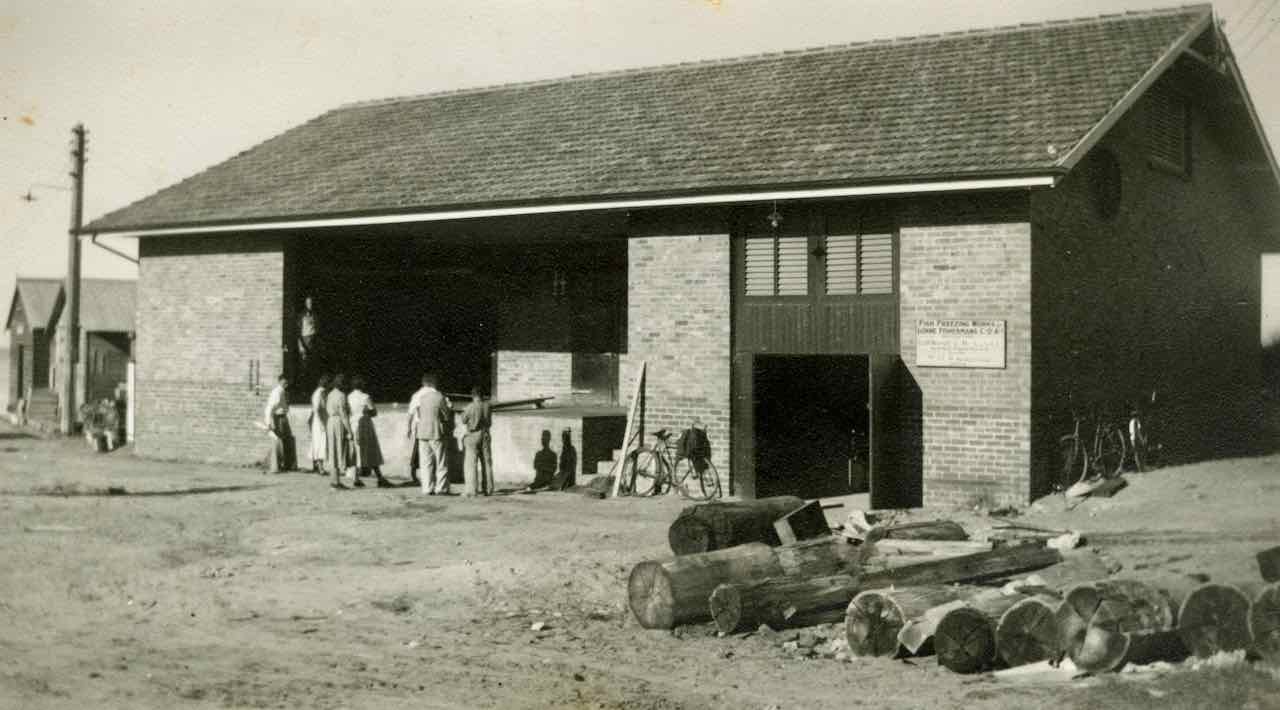
Lorne Freezing Works at Lorne Pier 1955. (LHS photo B476)
In 1949 the Co-op building was completed. It consisted of a fish filleting and packing area, a snap freezer with eight ton capacity, a smaller room for holding bait, and a small office. In the early 1950’s the industry peaked, with around 25 boats on the pier. All fishermen caught barracouta. For those who only caught couta they would work ashore to supplement their income. Several fishermen did well catching crayfish and in these early days, when no couta was about, some fishermen used long lines to catch gummy shark and snapper. The long lines were set at daylight and left for two to three hours and then retrieved.

Fishing Coop January 1986
The barracouta were caught using shiny ‘jigs’, no bait attached. When fish started to bite, the boat would circle up and throw out whitebait to keep the fish coming. Fish were ‘unhooked’ on a hooking board into the well of the boat. Before hooking boards were used, the fish were “winged”; each fish caught under the fisherman’s arm and unhooked into the boat well.
After returning to the pier, fish were unloaded and transferred to a wooden trolley which was pushed along a railway line to the Co-op to be cleaned and prepared for market. The rail line still runs along the front of the Co-op building.
Originally, to protect the boats in bad weather, a very old crane that had a wooden jib was used to lift the boats onto the pier. Later two cranes were used, but the boats lifted could not weigh more than three tonnes.
In 1972, the then secretary of the Co-op Gordon Bannister wrote in an application for funding to the Commonwealth Development Bank, that Lorne had 26 fishermen and that the industry supported 30 families. The application was unsuccessful, but not to be deterred they applied to the Rural Finance and Settlement Commission and in July of 1973 the commission offered a loan of $70,000 to upgrade the facilities.
Six year later, in a letter written by John Barker on behalf of the members, to the Rural Finance Commission, asking for a restructure of the Cooperative shareholding. He noted that only 12 fishermen remained in Lorne and that the decline in numbers was likely to continue.
In 1974 the new processing plant and retail store were finally added, allowing for an increase in the efficiency of the processing and an improvement in the quality of fish supplied. The future looked good for the Co-op, but the sudden absence of the barracouta and the decline in the number of families fishing, left Lorne as basically a crayfish port. The Co-op had given great service to the fishermen in Lorne.
10-12-1981 THURSDAY. LORNE MERCURY. INTERVIEW WITH PHILLIP EDDY.
Retail Manager,
Lorne Fishermen’s Co-operative.
by Tanya Lee & Barry Fulton.
Q. Briefly, what is the history of the Co-op?
A. The Lorne Fishermen’s Co-operative was set up in 1948, with assistance from the Victorian Government; it was intended to provide employment for men returning from the War, and at that time catered for 24 two man boats.
Q. Has it been successful?
A. Well, Lorne was the busiest Couta Port in Australia, at one stage, with an annual catch exceeding 1,000 tons. Now there are only ten boats, and we look forward to the day when Lorne has a safe anchorage to attract more fishermen. The couta catch has declined; it was down to! a ton last year. Most other co-op’s around the coast have gone out of business, or have been taken over by others, but the Lorne Co-op has survived, largely by diversifying into processing of fish, and handling frozen foods.
Q. Why do you catch less couta nowadays?
A. Water temperature changes the warmer water currents are not
favoured by couta. However the local fishermen still get hauls of schnapper, flake, crays, teraki, flathead, trevally, ling, yellow tail, leatherjacket and some couta.
Q. Is it enough?
A. No, in addition, trawlers working from other ports supply us with fresh fish, which we process, and sell. We also sell processed fish to the wholesale trade in Melbourne.
Q. Why is the new shop being opened?
A. We needed to upgrade our retail facilities, as there is such a big demand. In the summer months, particularly, there are often huge crowds down around the pier, fishing or just sightseeing. We’ve spent over $60,000 to improve the shop.
Q. What hours will you operate, and what will you sell?
A. We open now, from 9 am to 6 pm, but from next week on we’ll be open every day from 7-00 till 7-00, selling icecreams, drinks, frozen foods, fishing tackle and fish, of course! All at competetive Geelong prices.
Thanks to Henry Love for additional background information.