
COVID in Lorne
Infectious diseases have ripped through the fabric of humanity for thousands of years. More than 7 million people have died of COVID to July 2026. A flu pandemic killed 17 million people in 1918. The Black Death killed half of Europe’s population in the 14th century. Before it was eradicated, smallpox killed hundreds of thousands of people every year. It’s one of the most devastating diseases Europeans introduced to Indigenous peoples the world over – including in Australia. In 1789, smallpox was first found among Aboriginal people in the Sydney region.
COVID strikes. Scott Morrison is the Prime Minister. Daniel Andrews is the Premier of Victoria, and declared a state of emergency on 16 March 2020. Australia has closed its borders to the world and states hove closed their borders to each other. Pubs, pokies, cinemas, restaurants, cafés, indoor sports have been closed. Concerts, festivals, sports, including the AFL footy, have been cancelled. Horse racing is being held, with empty grandstands. Churches are closed. Only 10 people can attend funerals. Weddings can be conducted with no more than 5 people attending; the celebrant, bride, groom, and two witnesses.
Petrol is currently less than $1 per litre. Panic buying means there’s no toilet paper, disinfecting supplies or hand sanitiser on the shelves. Pasta, rice, flour, eggs, mince, canned tomatoes have been in limited supply. Supermarkets have restricted some products to one or two per shopper. One even had a limit of two cans per shopper. Tape is on the floors at the shops (that are open) to help distance shoppers (1.5m) from each other. Limited number of people are permitted inside the shops, therefore lineups outside the doors. Other non-essential shops and businesses are starting to close. Regional Newspapers close their doors after reporting the news for more than 100 years.
Office workers are working from home. Schools have closed and children are to be schooled at home called remote learning. Easter holidays must be spent at home. All non-essential travel banned. Fines are established for breaking the rules. Police (and defence forces) patrolling the streets (and between regions), beaches and checking in on those who are in quarantine (after returning or evacuating home from overseas or having the virus).
Shortages of masks, gowns, gloves for our front-line workers. Shortage of ventilators for the critically ill. Manufacturers, distilleries and other businesses switch their lines to help make visors, masks, hand sanitiser and Personal Protective Equipment. Arenas open up for the overflow of Covid-19 patients.
Children’s playgrounds are closed. Families start playing board games, like monopoly, and sit around a table talking to one another. We are to distance from each other. Press conferences daily from the government. The government throws money at businesses to try to keep the economy from imploding. Grants and loans. Some governments to pay 80% of employees wages where businesses cannot continue to do so. Daily updates on new cases and deaths.
Barely anyone on the roads. People wearing masks and gloves outside. Essential key workers are terrified to go to work. Medical field workers are afraid to go home to their families. This is the Novel Coronavirus (COVID – 19) Pandemic, as declared March 11th, 2020.
Covid 19 Pandemic began in Victoria in Melbourne in 2020. The initial wave began when a man arrived in Melbourne from Guangzhou, China, as Australia’s first confirmed coronavirus case. On 16 March 2020, Victoria declared a State of Emergency. Lockdown #1 commences: stay home; masks; social distancing; hand sanitising; home schooling; home business; no leaving home except for essential services; no travel.
March 26, 2020 recorded the first coronavirus deaths in Victoria. Victoria records 671 cases and 7 deaths. Lockdown #2 followed with stage four restrictions imposed. Melbourne encased in Australian Defence Force policed ‘ring of steel’. Stage four restrictions extended until October. Victorian death toll reaches 800.
Melbourne’s “ring of steel” ends. No cases or contacts recorded in Lorne. Lorne residents exemplary with adherence to mask, social distancing, and hygiene regulations. Some people moved to live in Lorne during Civic-19 Pandemic, working from home, with children enrolled in the local school. By 30 April 2024, over 6 million confirmed cases were recorded with more than 19,000 deaths attributed to Covid-19 worldwide.
“Business As Usual” was painted by Simon James Holloway during the first Covid-19 pandemic lockdown. The painting was acquired by the Lorne Historical Society thanks to the generous support of Auden and Allan Walls.
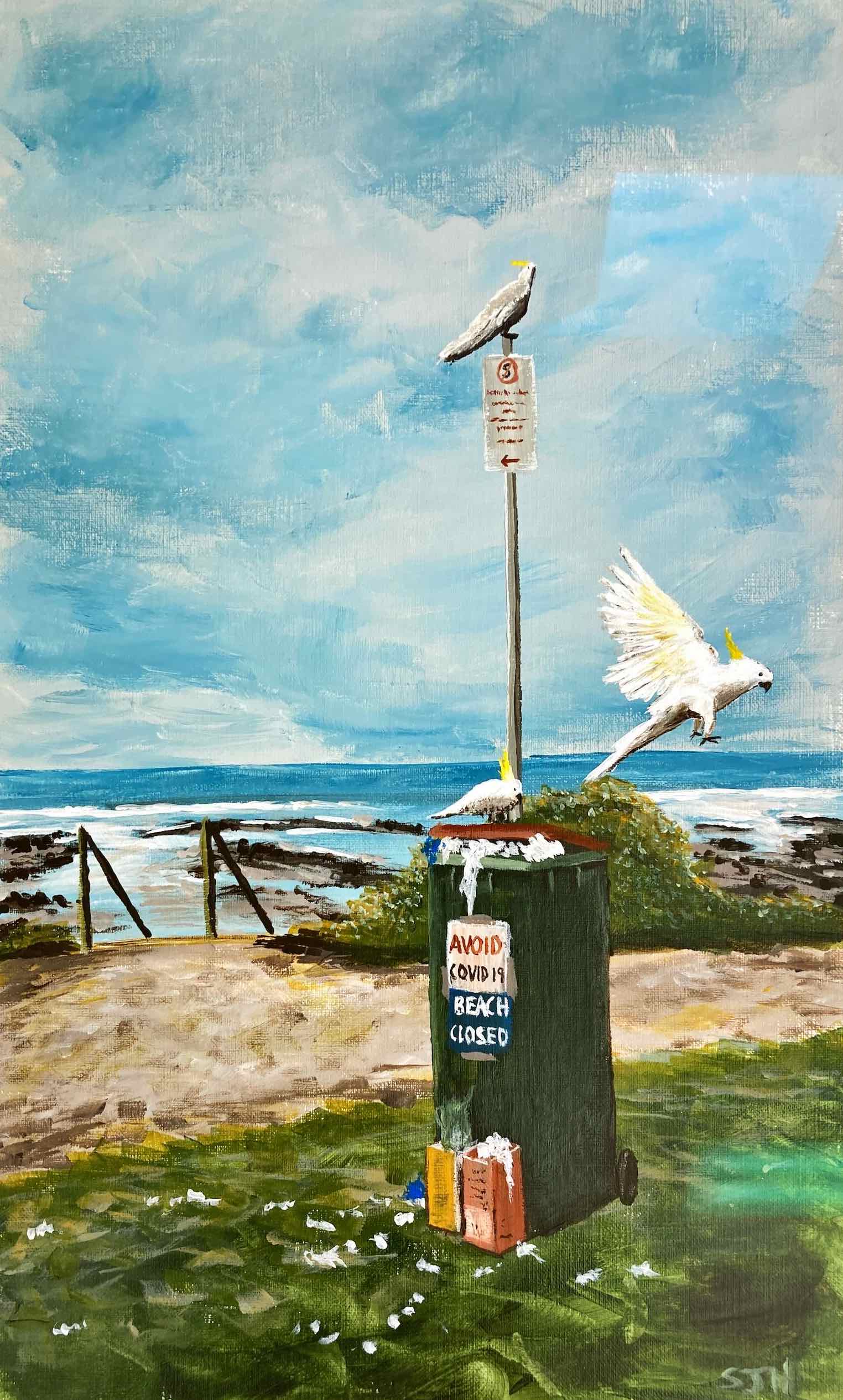
“Business As Usual”, painting by Simon James Holloway
Education
The COVID-19 pandemic brought unprecedented challenges and changes to Lorne P-12 College, affecting students, staff, and the wider community in profound ways. One significant impact was the influx of families moving to Lorne to work from home. This brought a unique dynamic to our school community, as these families sought the safety and tranquility of our rural setting.
While we welcomed many new faces during this time, the sudden increase in student numbers put pressure on our resources. Unfortunately, many of these new students were not included in the initial student counts, leading to strained resources and logistical challenges. Our staff worked tirelessly to accommodate the increased demand, ensuring that all students received the support they needed despite the sudden surge in enrolment. However, this situation also had its downsides. Once the lockdowns ended, many of these families returned to their original locations, resulting in a dramatic drop in our student numbers.
The pandemic also highlighted the challenges of balancing in-person and online learning. Many families used our school as a temporary solution, even though their current schools provided online learning options. This led to inconsistencies in the students’ learning experiences and put additional pressure on our teachers, who had to manage a constantly changing student body.
For our regular students, the pandemic disrupted their usual school experiences. Many faced difficulties adjusting to online learning, and the lack of in-person interaction took a toll on their social development and mental health. However, it also fostered a sense of independence and self-discipline in our students as they navigated their studies in a more self-directed manner.
Sources:
- Linton and Mandy Ferguson 2024
- Carly Stafford, Principal Lorne P-12 College, July 2024
- ‘The Conversation – Science’, 14 July 2026, AU Edition
- “A History of the Surf Coast Anglican Churches” by Norma Morrison

