
Shipwrecks Near Lorne
Bass straight is notorious for many shipwrecks along the shores. Strong winds turned the shallow waters into mountainous seas and many ships became victims.
Some ship disasters include:
- Foam
- Godfrey
- Henry
- Hinemoa
- Osprey
- Otway
- Paul Jones
- Rebel
- Speculant
- Unknown
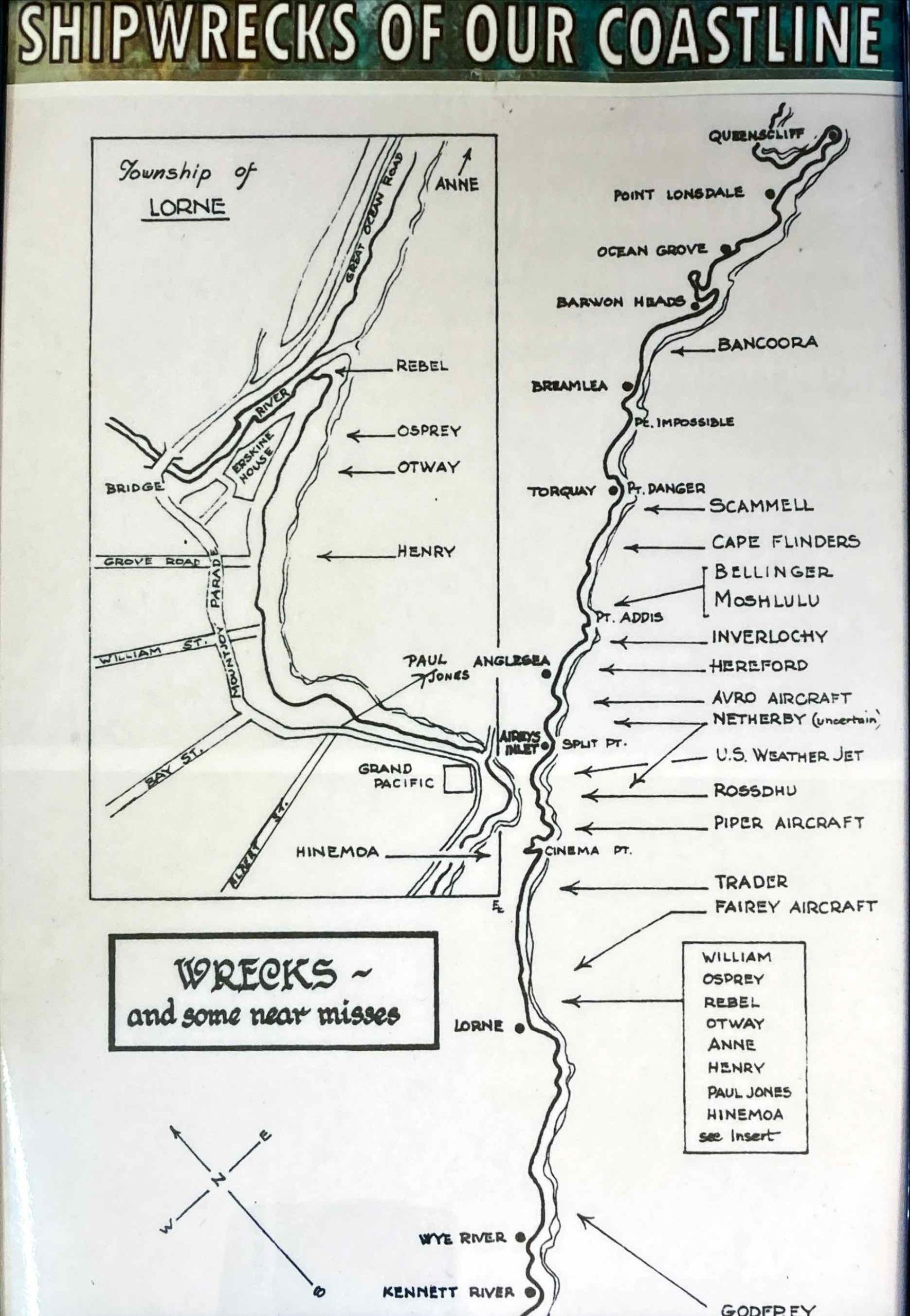
Shipwrecks near Lorne
Lorne Coast Shipwreck Walk
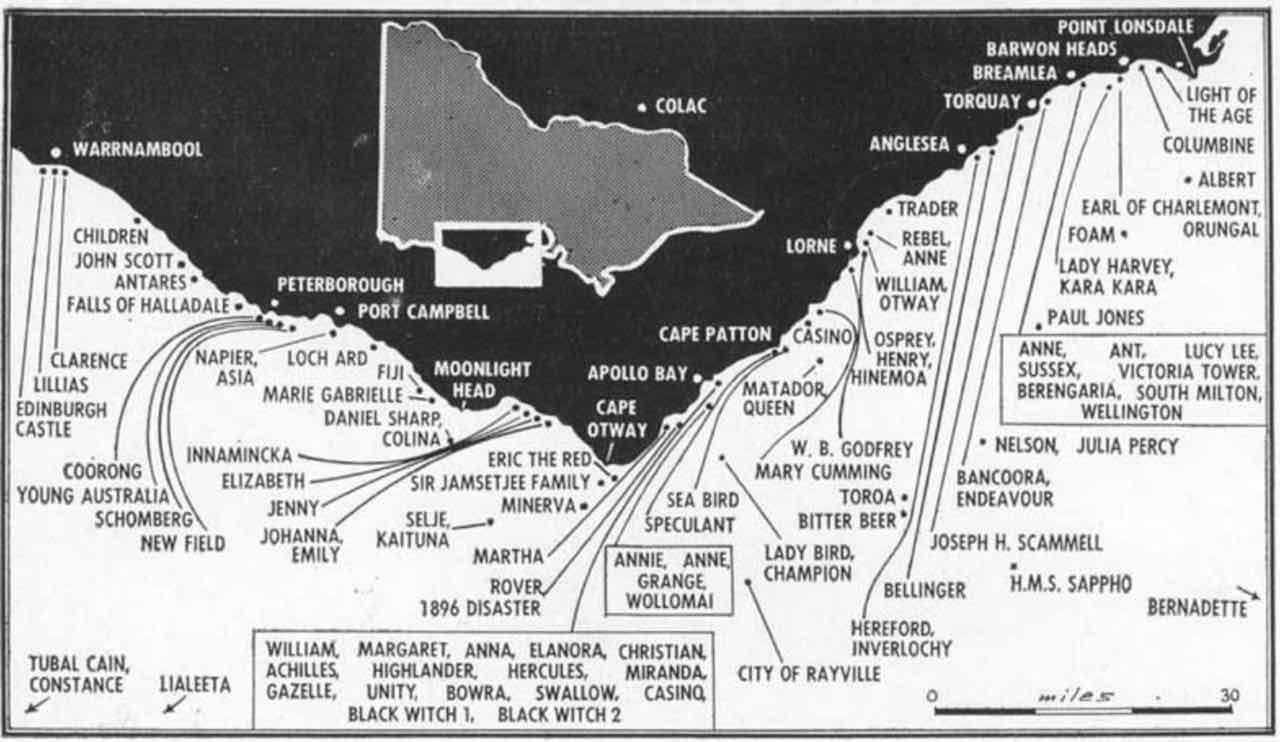
Image from Wrecks along the Great Ocean Road by J. K. Loney, published 1973
Foam
The ketch “Foam” a coasting craft of about 30tons, while on a run from Louttit Bay to Melbourne on the 30th January, 1880, foundered or capsized in one of the terrific easterly gales which periodically visit that part of the coast.
On the morning the “FOAM” weighed anchor, her crew consisting of William Anderson, Joseph Gay, William Collins, and a little boy Harris, who was a passenger. Till noon the sea was beautifully calm, but about three o’clock the treacherous east wind sprang up.
It appears that the “FOAM”, making all possible headway to reach the heads and thus avoid weathering the gale with the disadvantage of a lee shore, had upturned through carrying more sail than was safe, considering her light ballast and the fitful blasts of wind. On the coast were found, a few mornings after, the boat, a lifebuoy, the hatches – sad relics, which tell in their silent way the fate of the craft and her hapless crew.
Godfrey
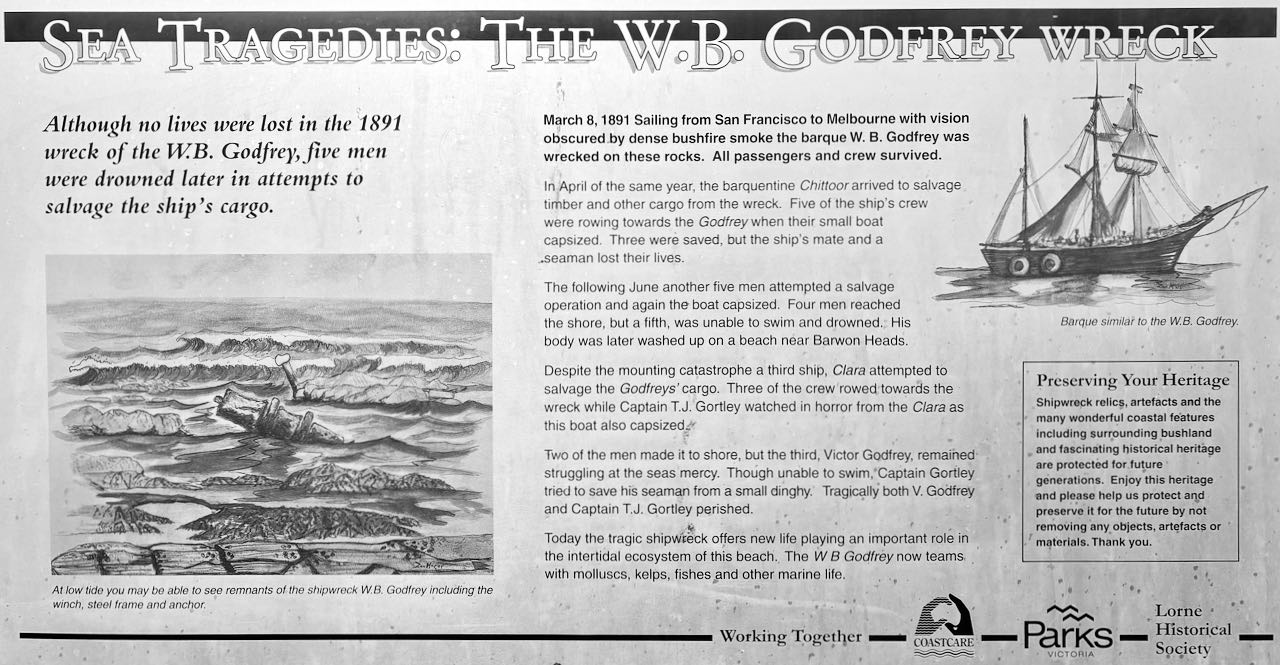
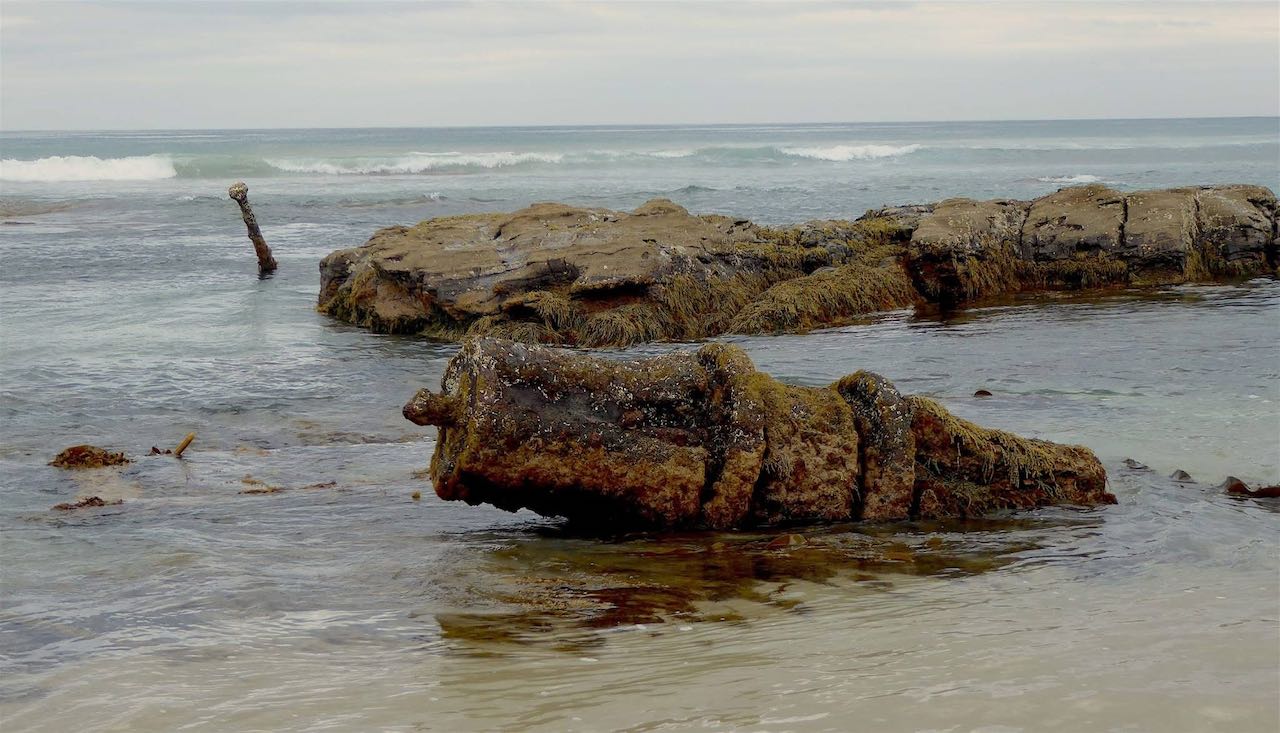
Photo showing part of the anchor and winding gear.
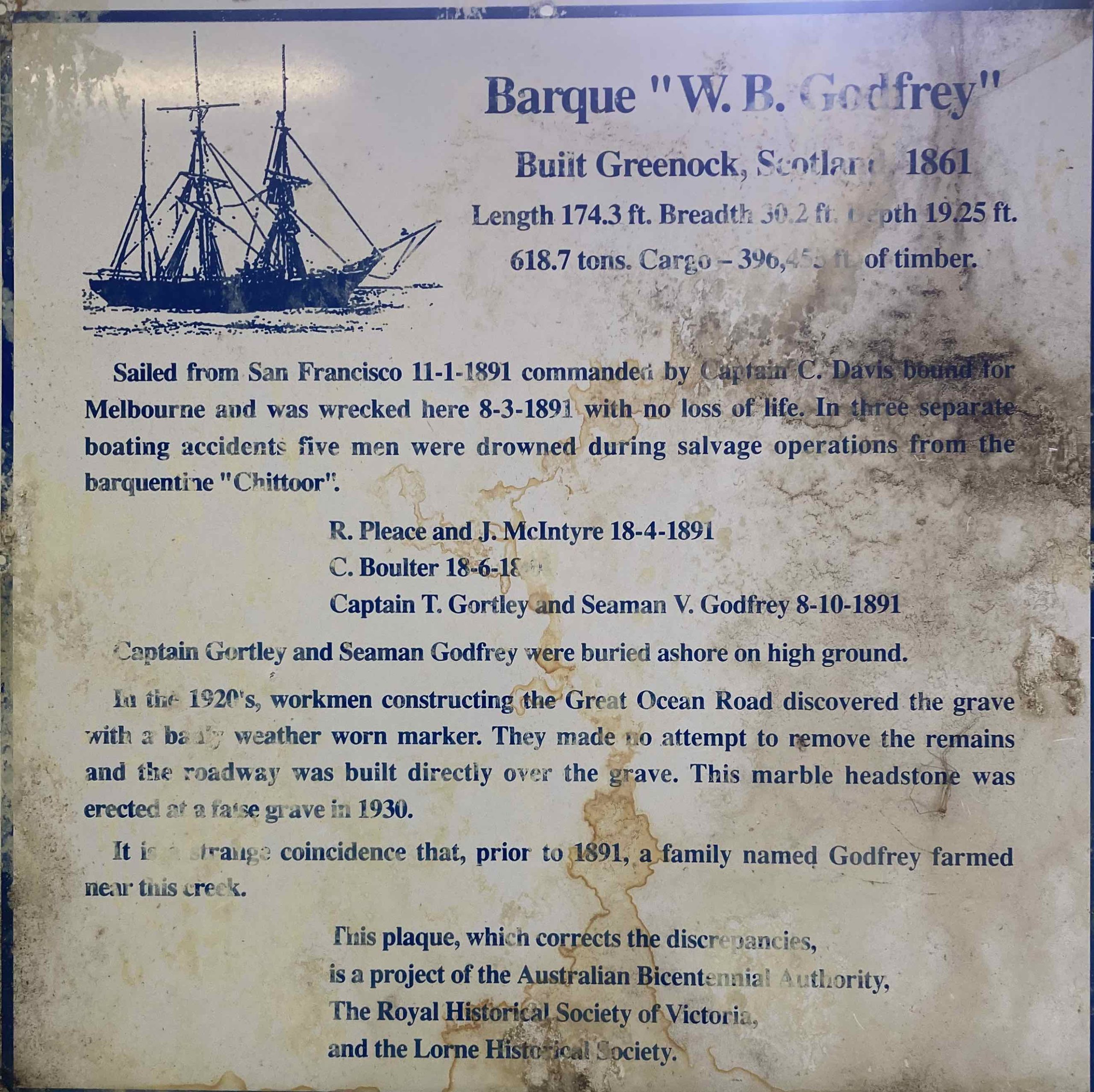
Barque “W. B. Godfrey”
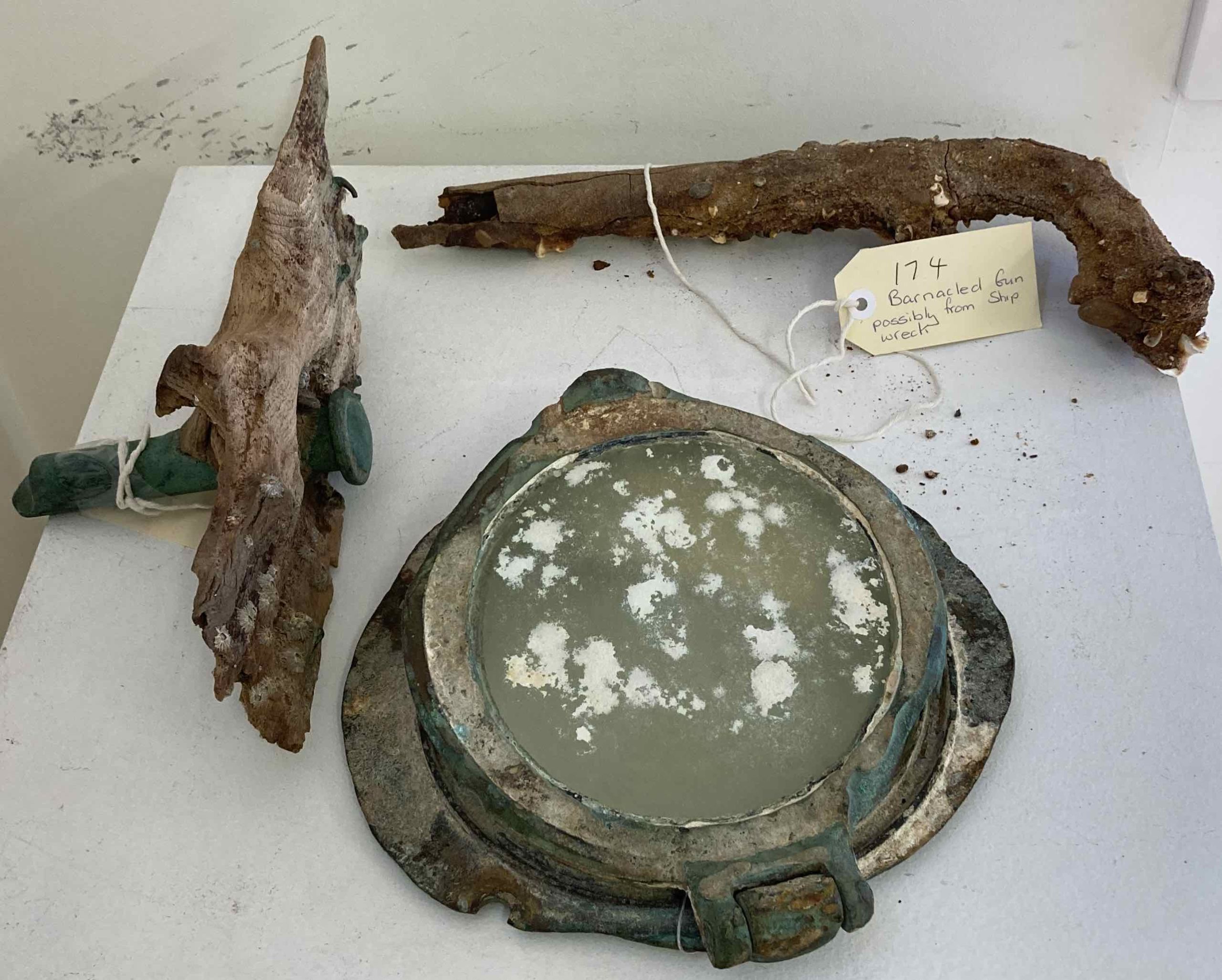
1891 artefacts from the wreck of the Godfrey: bolt from ship, barnacled gun, ship’s porthole
Henry
Length 48 ft, 2 master ketch, beam 13.9 ft, built 1854, 32 tons
The ketch Henry visited Lorne regularly with provisions, building materials and general supplies. After her cargo was unloaded, then timber, wattle bark or ballast was taken on board. The only landing point was a small jetty near the mouth of the Erskine river, but it was found to be more convenient to beach the vessel on a rising tide. After reloading she was winched off on a falling tide. During a visit in August 1878 a strong wind drove her hard ashore. Efforts to refloat her failed and soon after a rising wind and sea from the east battered her to pieces.
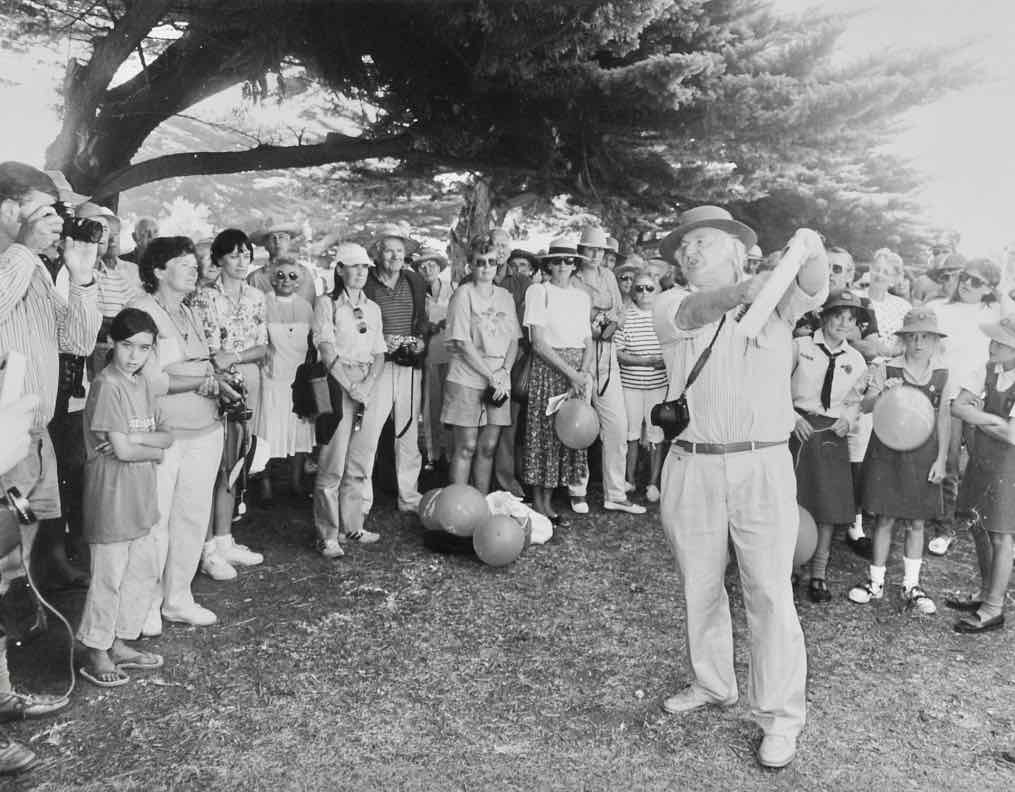
Jack Loney at the unveiling of the plaque for the “Henry”, 17 March 1991.
29-8-1968 THURSDAY. THE LORNE NEWS. WRECK OF THE “HENRY”.
It was 90 years ago last week that the “HENRY” was wrecked on the front beach. The ketch, which was Lorne’s chief link for many years with the outside world prior to the construction of the track from Winchelsea, carried provisions and building materials, and it was usual to beach her on a rising tide, and use kedge anchors to haul her onto the beach. After unloading, wattle bark and timber, all ballast, was taken aboard, and she floated off on a rising tide. But during the 3rd week in August 1878, on one of her periodical visits, she was driven hard ashore by a strong wind, and efforts to refloat her were of no avail. Then a strong easterly sprang up, and the 32 ton ketch was soon reduced to battered wreckage. Most of her sails, rigging and fittings were salvaged.
Hinemoa
Length 271.1 ft, 4 masted barque, beam 41.9 ft, depth 25.2 ft, 2283 tons, built in Greenock, 1890
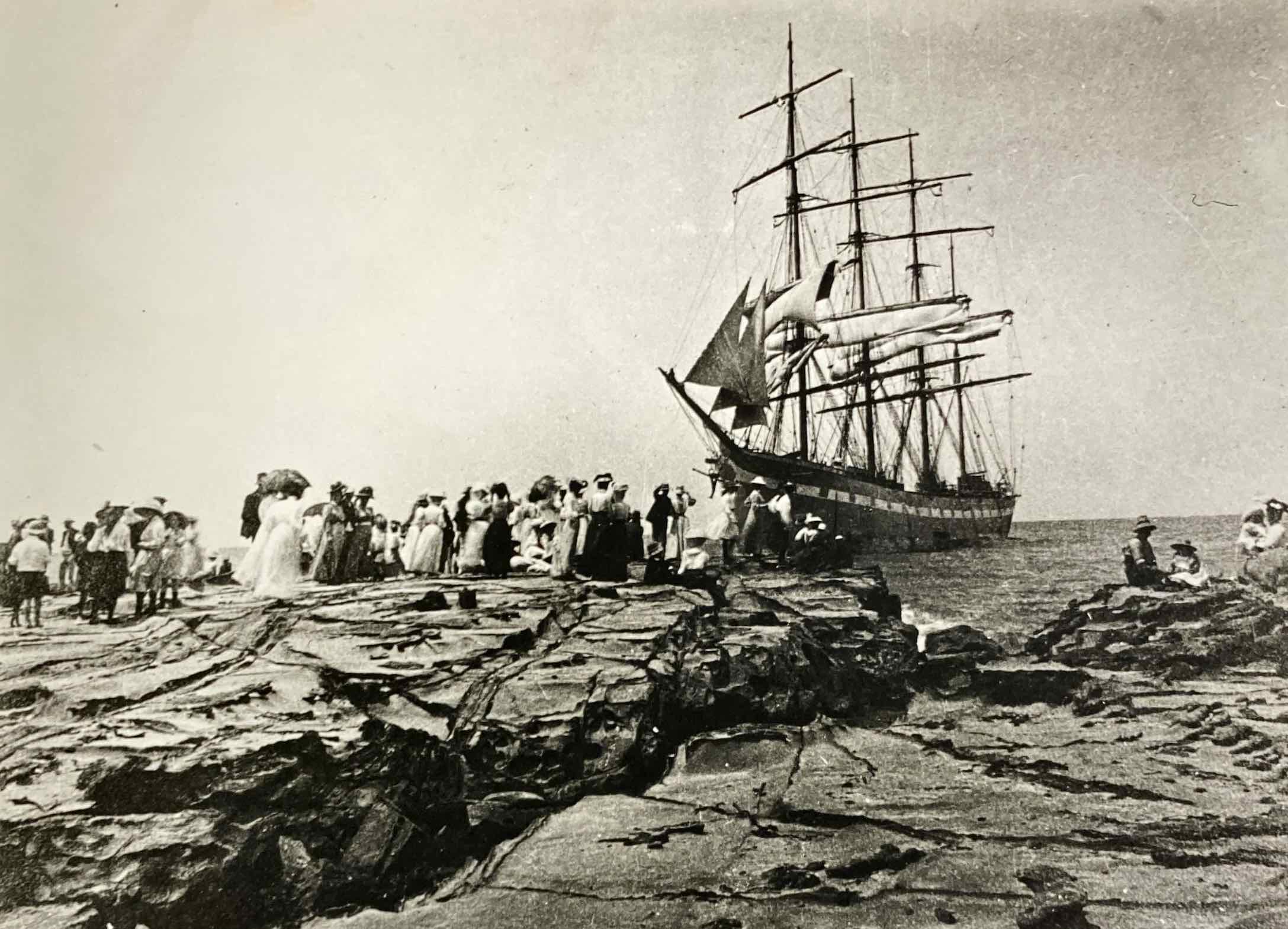
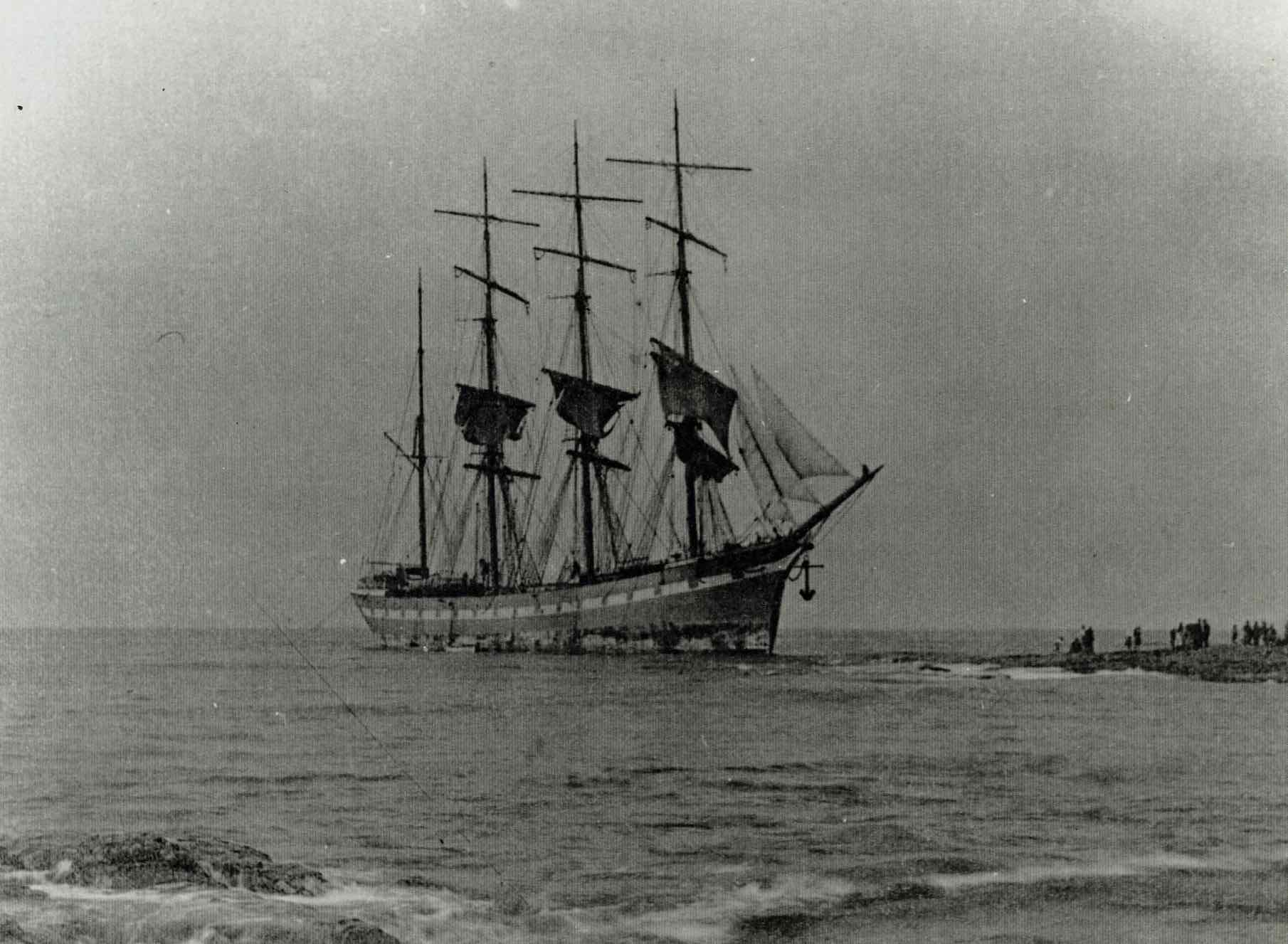
The four masted steel barque Hinemoa commanded by Captain Royan, grounded on the 21st January 1908 after losing her bearings due to thick smoke caused by fierce bushfires. The ship sat on an even keel with all sails set until she was towed off the next day by the tug Eagle. Her sailing days ended when she was torpedoed by a German submarine in the English Channel on the 7th September 1917.
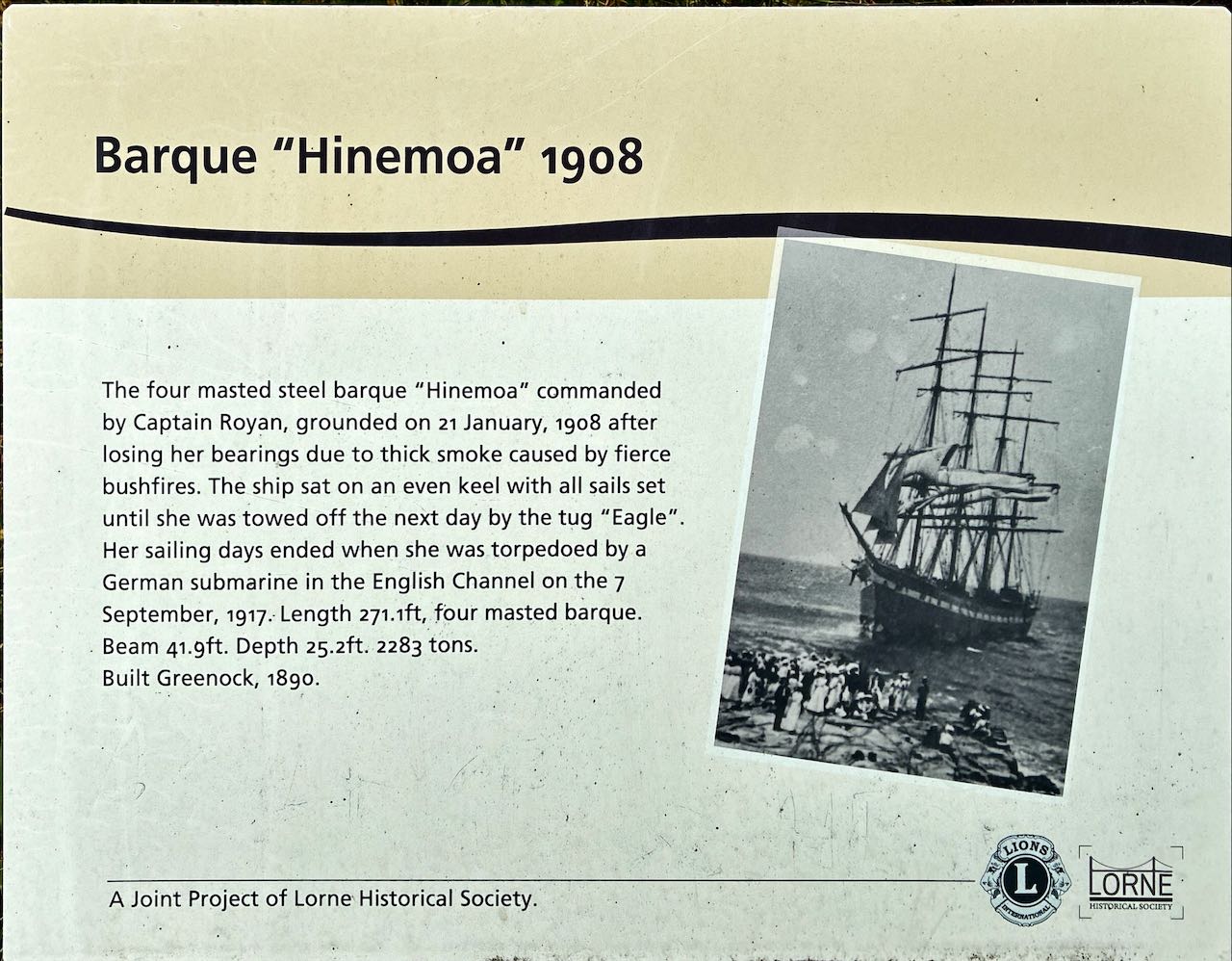
1908, Hinemoa
-
- Stranding of “Hinemoa” Pt Grey Lorne
-
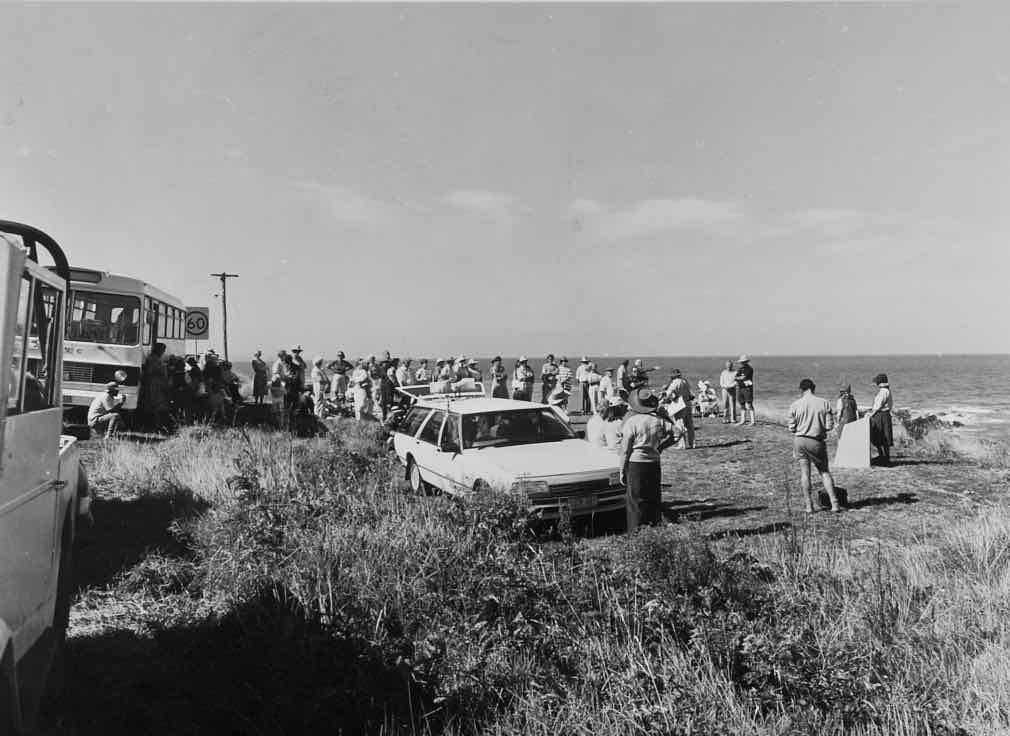
- Unveiling the shipwreck plaque for the Hinemoa, 17th March 1991
Osprey
Length 78.8, 3-master schooner, beam 20.7 ft, depth 13.7 ft, 104 tons, built in Bristol 1834.
The schooner Osprey under the command of Captain Hawkins, went ashore with two anchors down early on Sunday morning 18th June 1854. An easterly wind was blowing a gale and huge waves were breaking over the stranded vessel. All hands and most of the ship’s gear was saved. When the storm abated, she was left lying on her side, only a few yards out, but badly sanded up. Her owners (Messrs Morrison & Co. Geelong) believed she could be salvaged, but their attempts failed and she became a total wreck. The ship had a figurehead in the form of an osprey.
Victorian Heritage Database Report
In its earlier life under British owners, the Bristol-built three masted wooden schooner Osprey is known to have traded between the British Isles and Indian, Asian and Australian ports such as Batavia, Ceylon, Surabaya, and Sydney (Lloyds 1835, 1840, 1845). It was sold to Hobart merchants Richard Burns and Henry White in 1843 who operated the Osprey between Hobart, Batavia, Surabaya, Melbourne and Sydney. Between January 1849 and June 30 1850 the Osprey left Hobart Town for San Francisco, for the gold rush, arriving back in Hobart Town on 28 January 1851 (O’May). It was then sold to Melbourne merchant Rueben Burnett in October 1852, who after seven months sold it to Henry Alfred Coffey, Alexander Hill and John McFarlane all merchants of Melbourne. After a period of four months in August 1853 this Melbourne syndicate sold their shares to Geelong merchants Sydney and Richard Morrison. During this period the Osprey traded to Hobart, Adelaide, Geelong, Lorne and Portland (Syme). The Osprey was said to have been involved in the timber trade between Melbourne, Geelong and Lorne (Cecil & Carr, 1988). After completing a voyage from Adelaide to Geelong with six passengers and a cargo of hay, bran and flour on 10 May 1854, the next and last recorded voyage of the Osprey was from Geelong for Louttit Bay. Early on the morning of 18 June 1854 while anchored with two anchors out under the command of Captain Hawkins, an easterly gale caused the vessel to drag and be blown ashore near the mouth of the Erskine River in shallow water. Although pounding seas were breaking over the vessel there was no loss of life and most of the gear was saved (Argus 28/6/1854). After the storm the vessel was lying on its side and was heavily sanded up , and despite the hopes of the owners it could be refloated became a total wreck. The Osprey was believed to be insured (GA 27/6/1854). Captain Hawkins had previously been fined for not putting down a second anchor during a gale on 29 March 1854 which forced him to leave Geelong under duress of weather (Syme). Local folklore as early as 1875 identified a site to the south of the Erskine River as being that of the Osprey (Cecil & Carr, 1988). However a survey in December 1933, when Erskine River floods washed out the river exposing wreckage, described the Osprey identification as “unlikely” being consistent with a wreck of “more than double 66 tons”. However the author believed the Osprey to be 66 ton vessel, and not a 149 ton vessel (Stribling , 1934), and in fact in all respects this wreckage matches exactly the recorded dimensions of the Osprey . This is significant as this wreckage was identified as the belonging to the Rebel, even though it does not match the Rebel’s dimensions. Both historically and archaeologically there is no evidence to suggest the Rebel was totally wrecked at Lorne, rather that it was in fact refloated (see database entry for Rebel). Timber taken from a site near the rivermouth has been confirmed as being Quercus sp.(white oak) indicating it was a vessel built in the northern hemisphere. Wreckage and artefactual remains include the keelson, frames, outer planking, copper bolts, trenails, iron fastenings, copper sheathing (with marking ‘P GRENFE (LL?) 20’, brass tacks and horsehair. The area of site is 10m long and between 4.5 and 5.5m wide (MHU Wreck Inspection Report, 1995). Some planking and frames were removed from the site in 1973, while sometime prior to 1984 most of the remains of wreckage along the front beach at Lorne were removed by the Shire of Winchelsea in order to clean up the beach.(Cecil & Carr, 1988). Depending on beach formation and sand levels, occasionally two or three of the lower frames can be seen protruding from a gutter north of, and level with the tip of the rock groyne, submerged but visible at low tide.
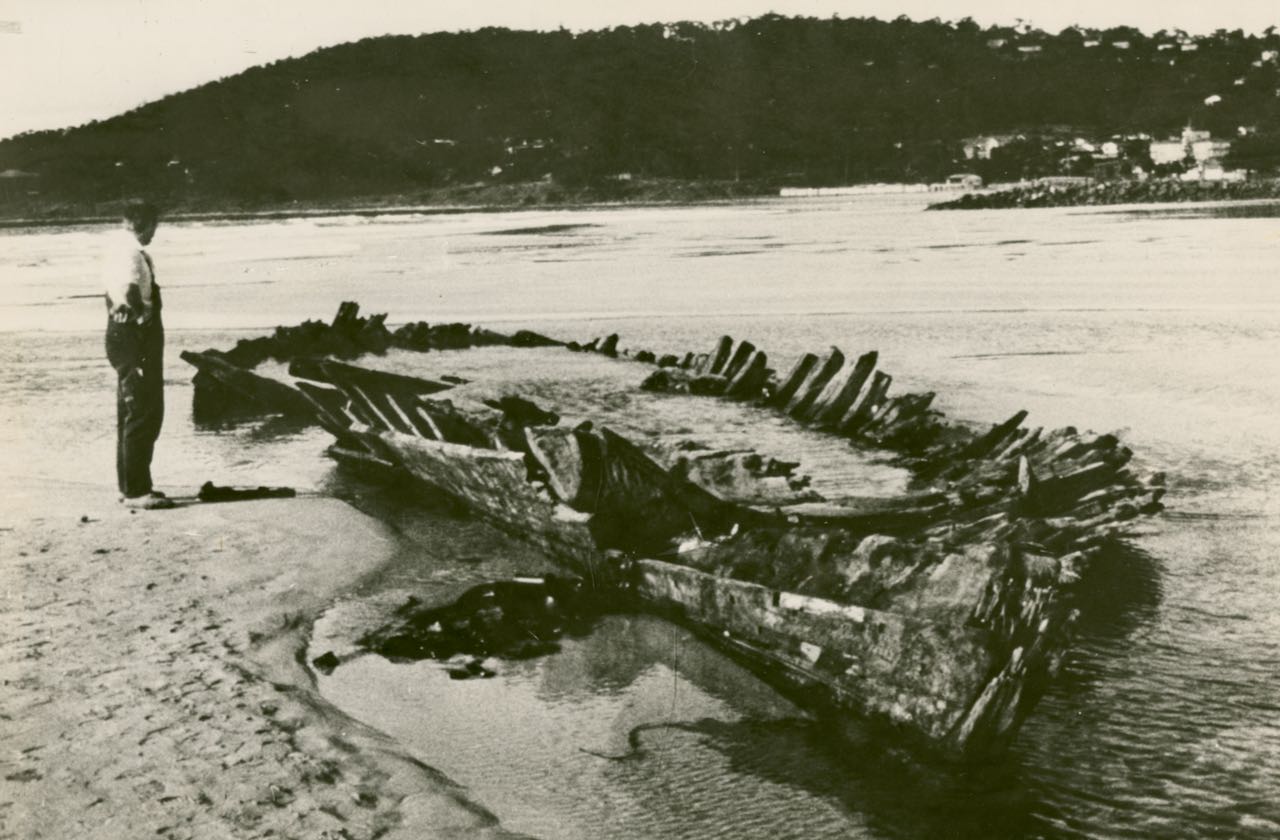
C1970s Remains of the wreck the Osprey. (LHS photo 8544)
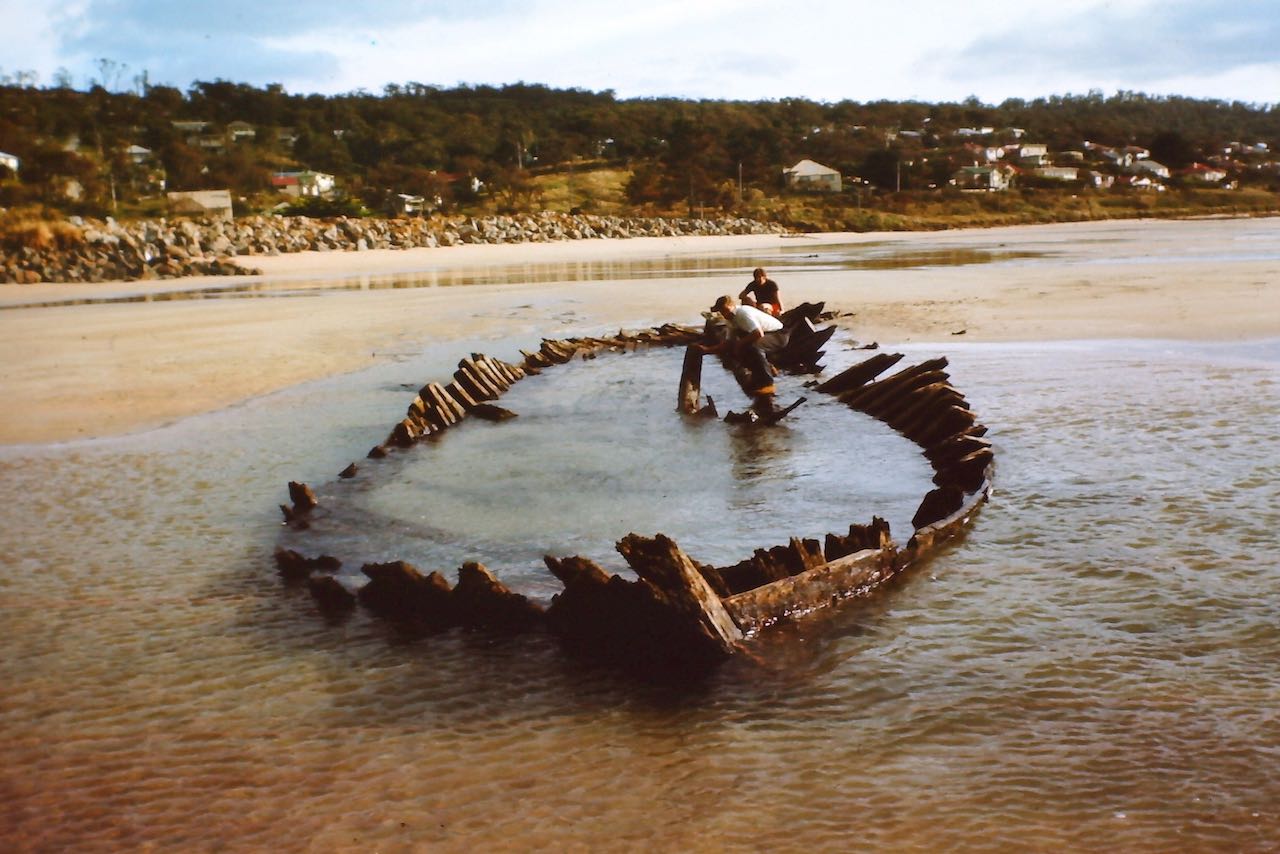
Wreck of the Osprey, photo Leigh Hammerton
Otway
Length 48.6 ft beam 13.4 ft, depth 5.7 ft, 33 tons, built inHobart, 1850
The schooner Otway registered at Geelong, carried provisions for local storekeepers. She was lost when heavy seas and gale force winds pounded her, finally forcing her ashore, where she listed badly, filled with sand and became a total wreck.
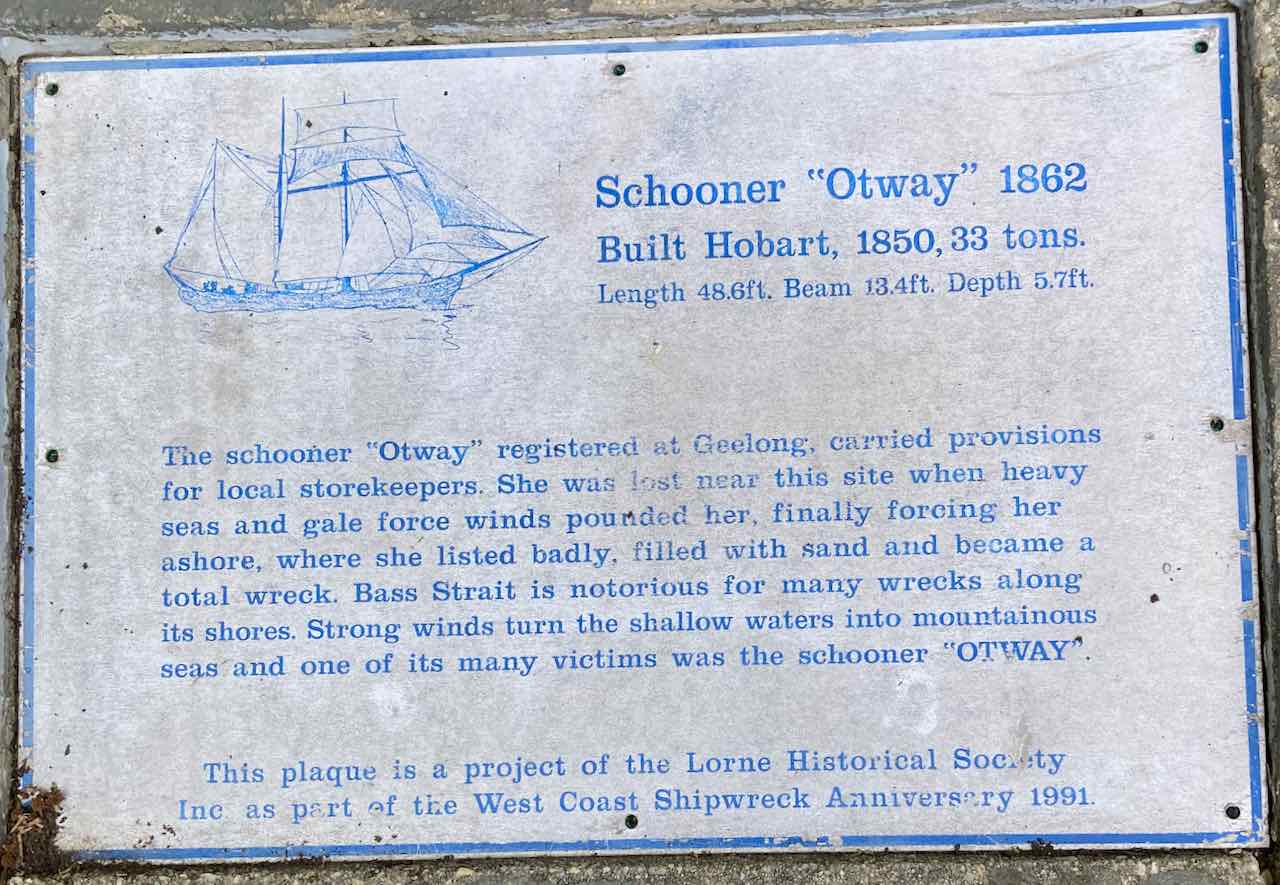
Otway shipwreck plaque
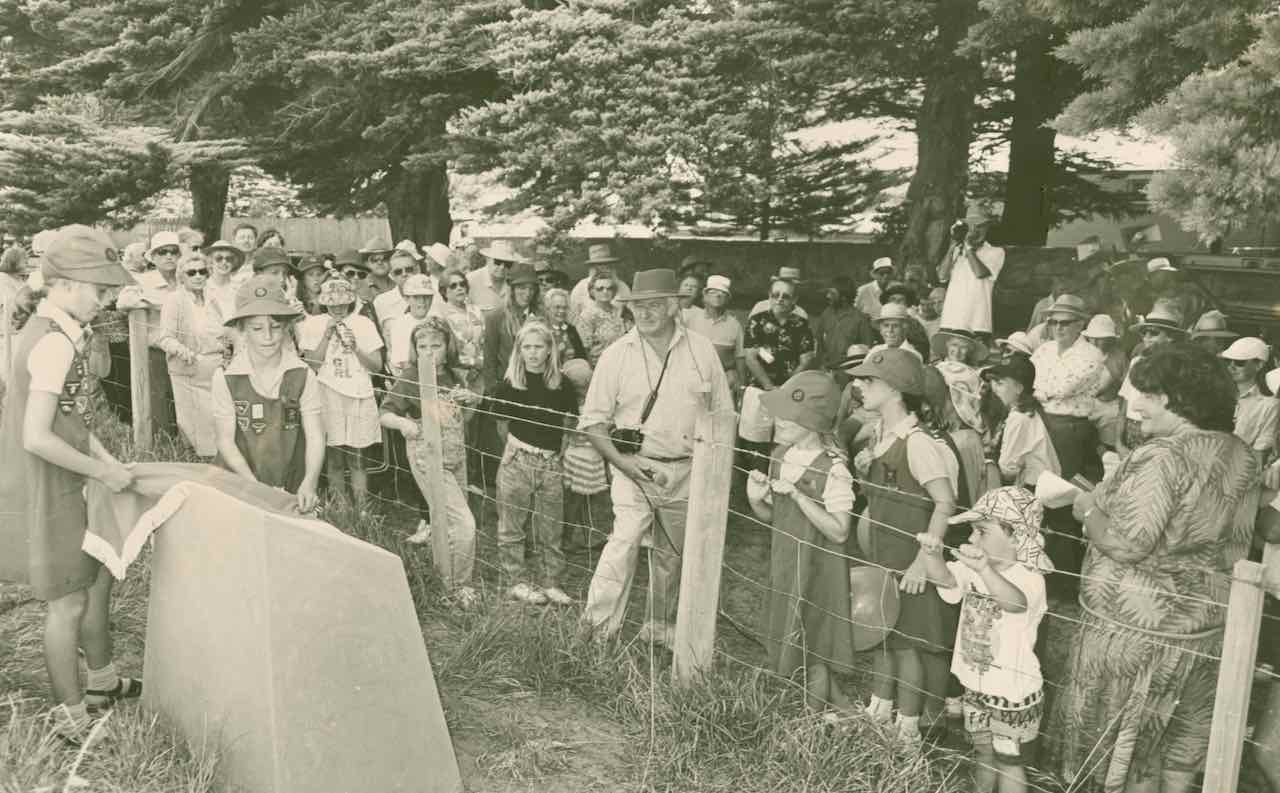
Jane Harrison and Sarah Boyle unveiling the Otway plaque, 17 March 1991.

Schooner “Otway” 1862
Paul Jones
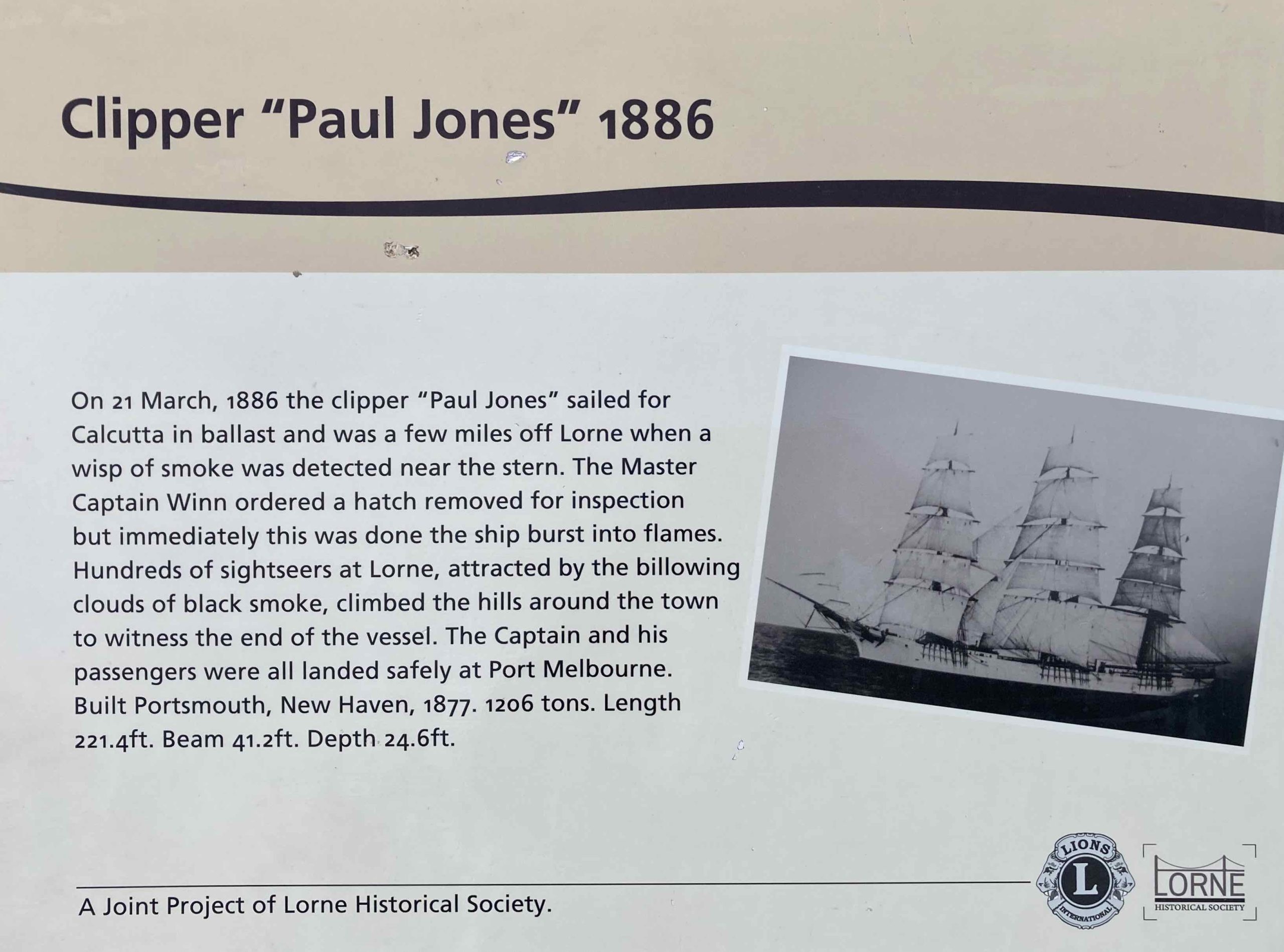
Plaque on Doug Stirling Walk, below Lorne Hospital
Rebel
Length 71 .8 ft, 2 masted schooner, beam 17.9 ft, 104 tons, built in Yarmonth, 1833
The Schooner Rebel, registered at Geelong, was thought to have been wrecked on the 17th February 1855, during a south easterly gale. The common practice in those days, was for the ship to put down kedge anchors and come in on the rising tide. The ship was then unloaded at low tide, then reloaded and winched back out on the next high tide.
After 1855, there are reports that show that the Rebel was trading along the Australian coast. It seems the Rebel was refloated and was never wrecked at Lorne.
-
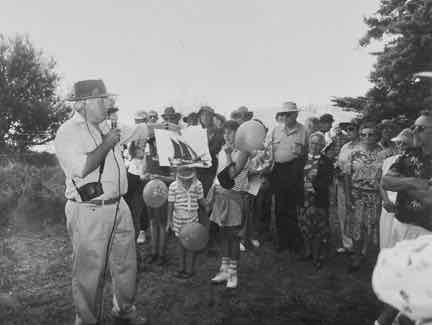
- Jack Loney at the unveiling of the shipwreck plaques
-
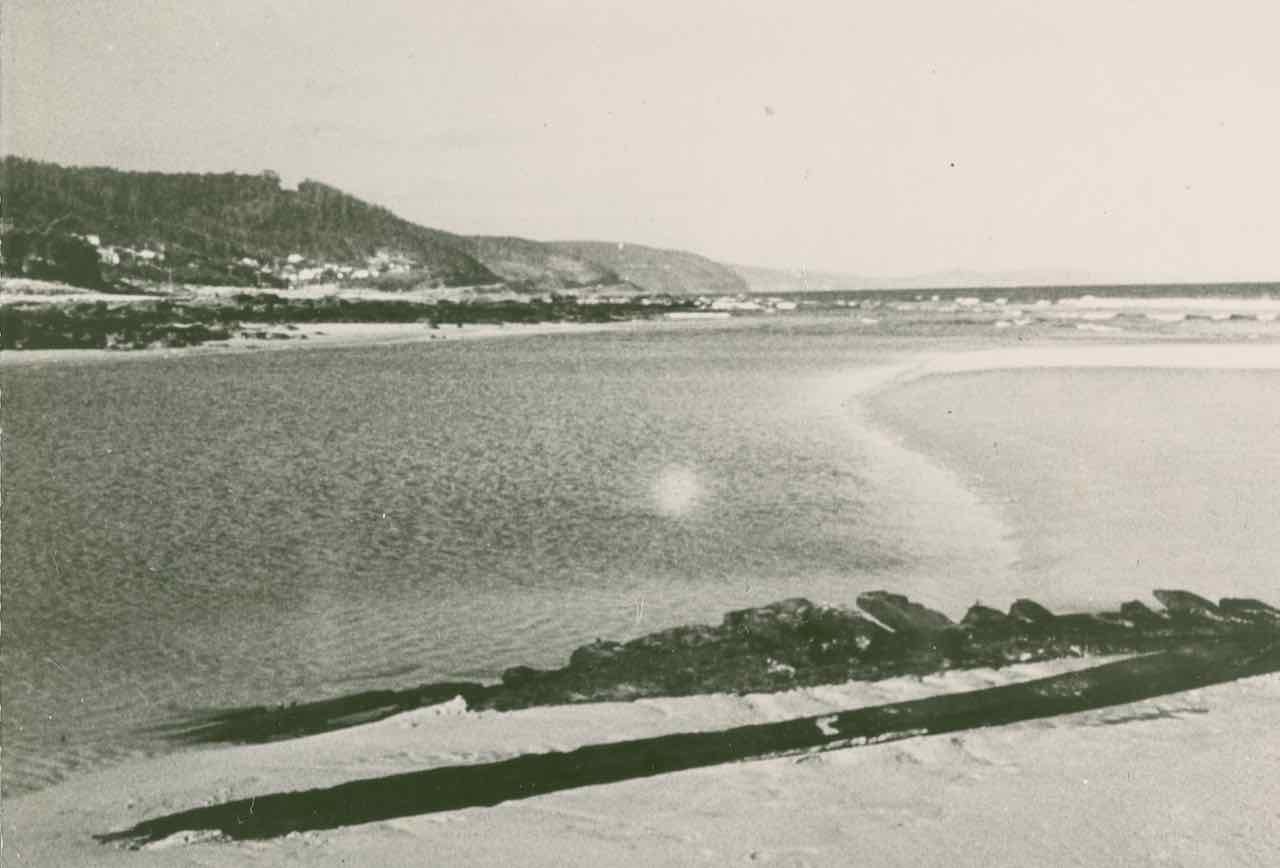
- Unknown shipwreck in the Erskine river estuary
-
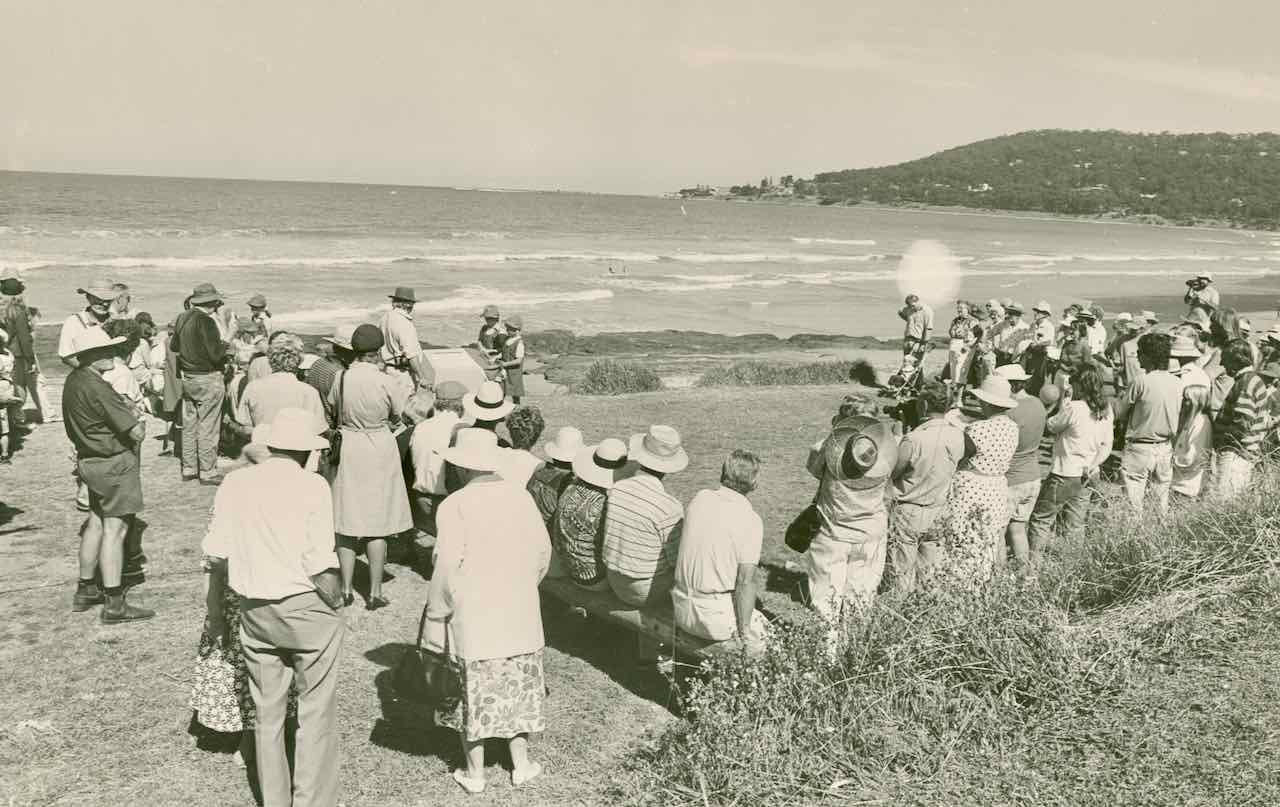
- Rebekah Boyle and Sarah Stribling (Brownies) unveiling plaque for Rebel, 17 March 1991
Speculant
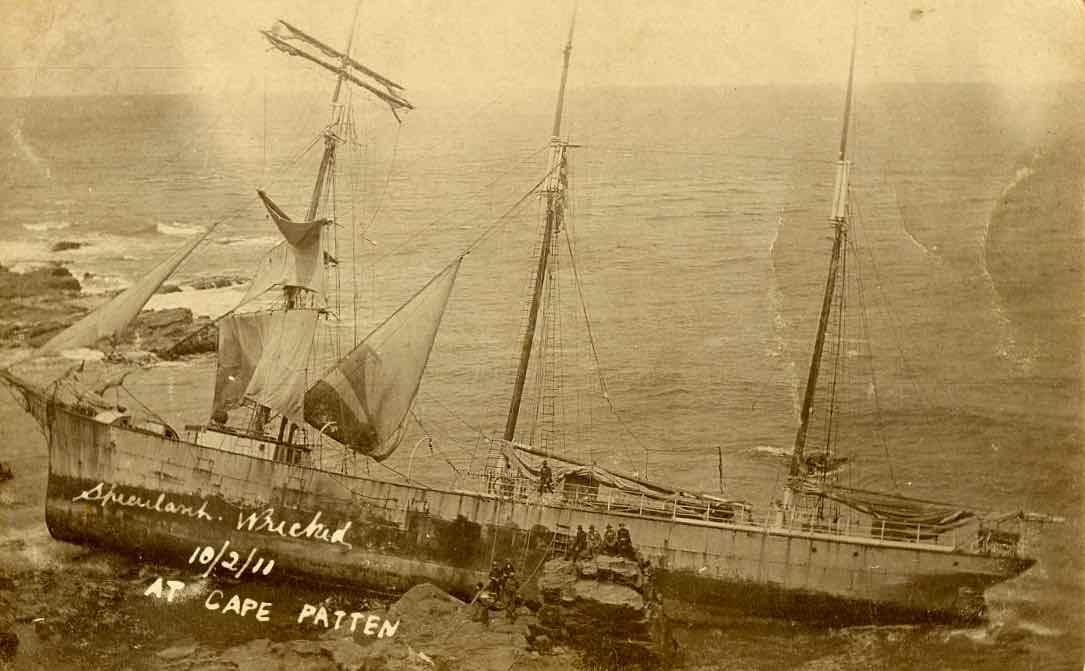
Speculate wreck, Cape Pattern, 10th February 1911
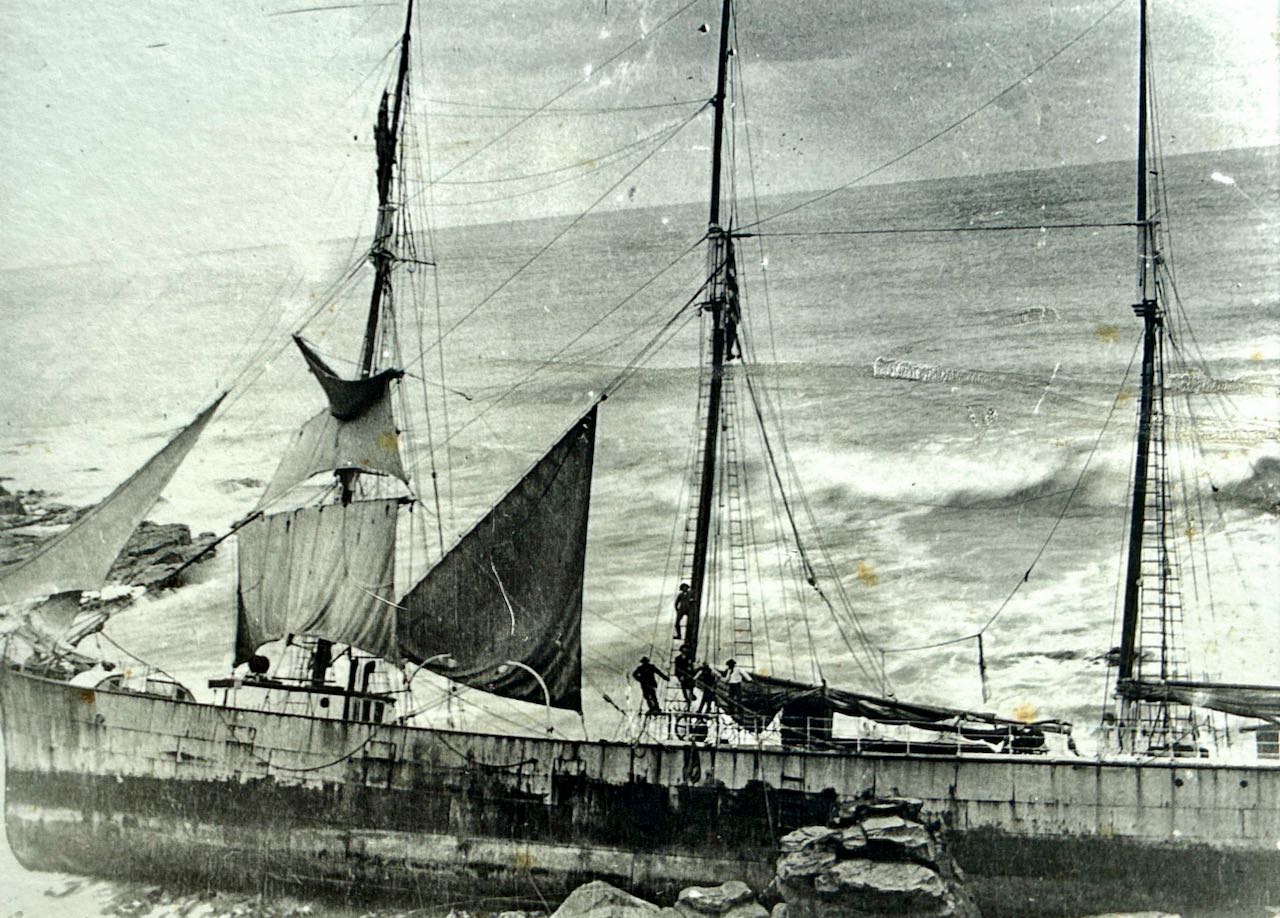
1911, Wreck of Speculant
Unknown
Found in the Erskine estuary. Was removed, but has not been identified.
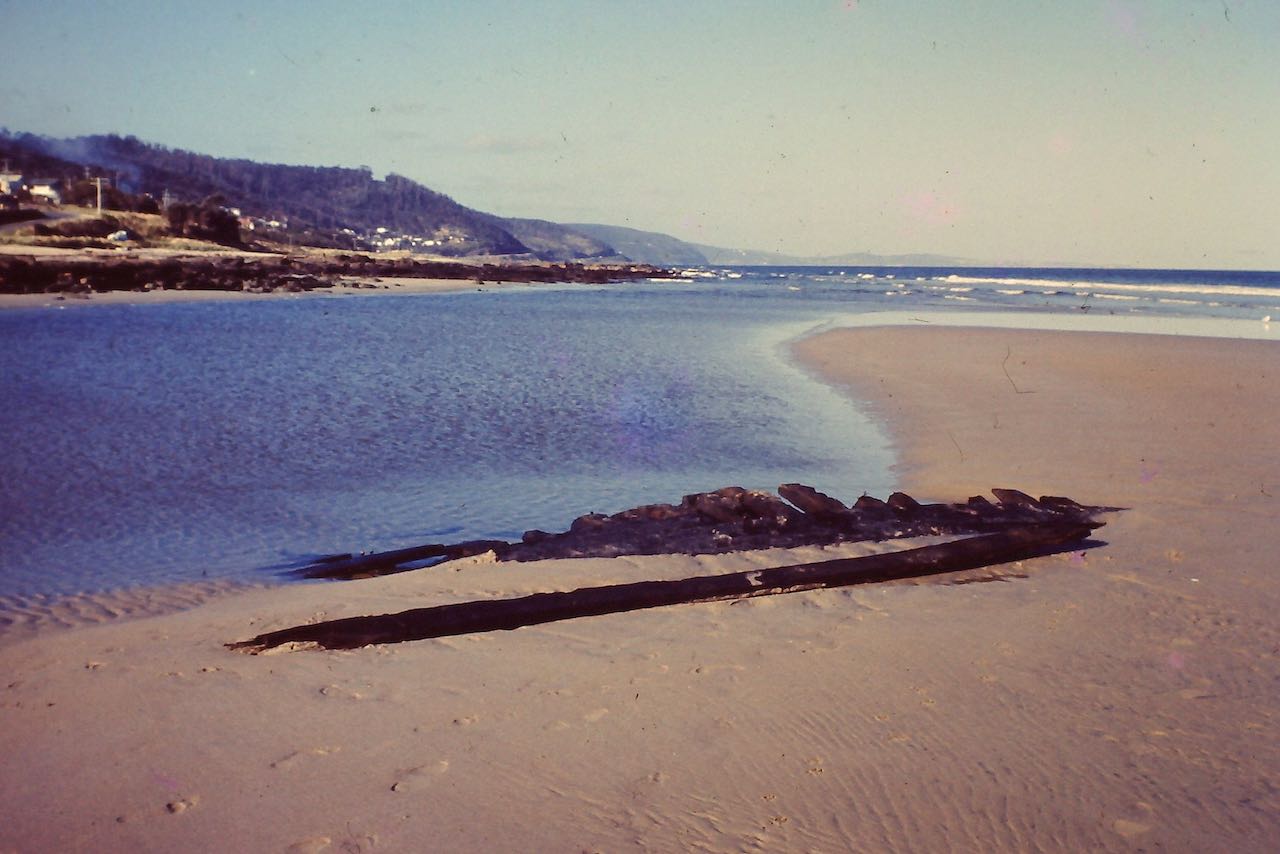
Keel of boat near Swing Bridge.
Sources:
- AUSTRALIA’S SHIPWRECK COAST by Jack Loney
- Shipwrecks Along the Great Ocean Road, by J. K. Money, 1967
- WRECKS, Along The Great Ocean Road, Jack Coney, 1976
- Victorian Heritage Database Report (http://vhd.heritage.vic.gov.au/shipwrecks/result_detail/508?print=true)

