Lorne
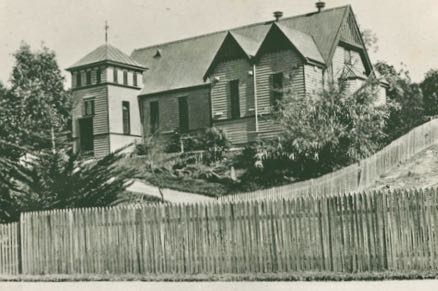
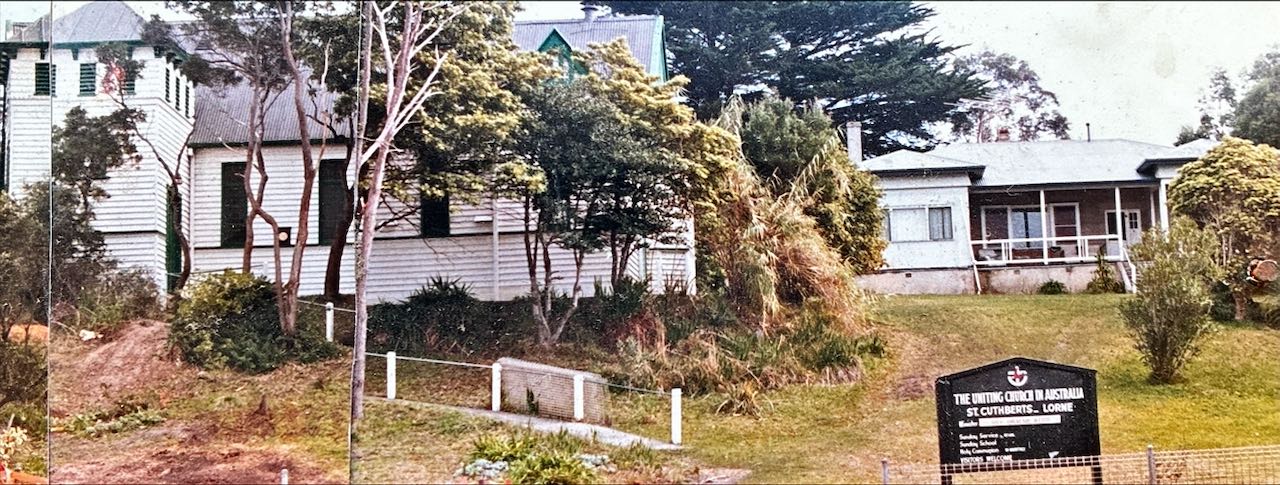
St Cuthberts Church was built in 1892 by Andrew Sanger, uncle of Doug Stirling. It was built with baltic pine that arrived in Lorne in Australia as ballast on ships coming from Europe. It also used red pine that was sent out from America for architrave and skirting boards, all hand-planed on the spot.
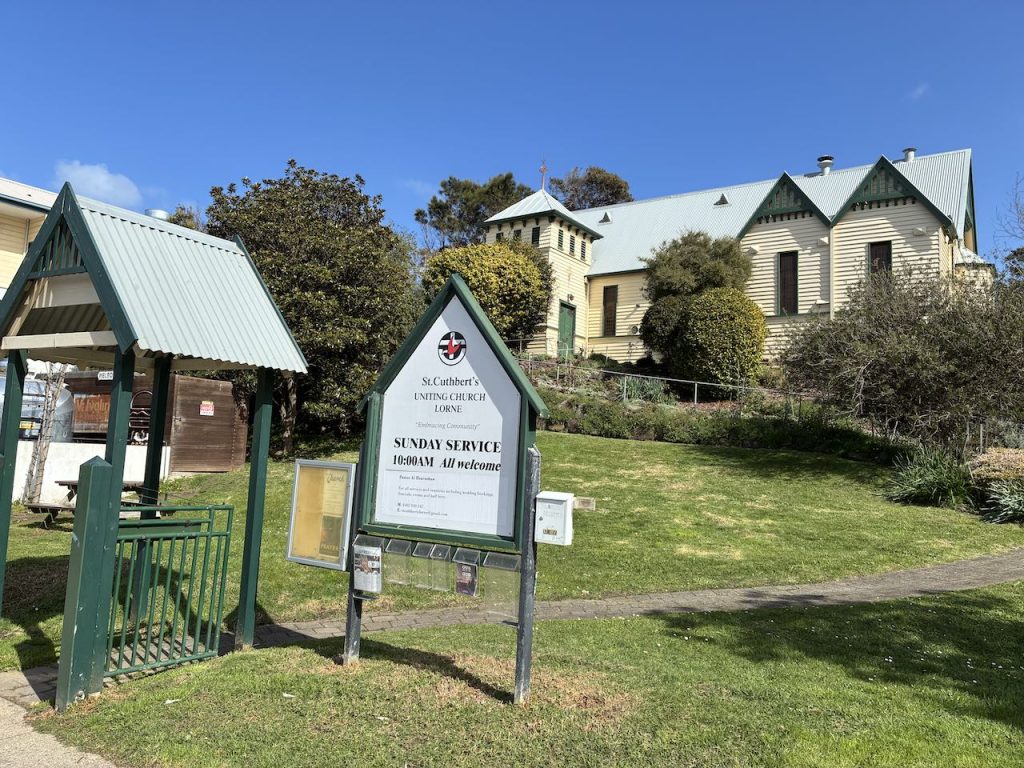
2026, St Cuthbert’s Uniting Church Lorne
Summary Time Line
- 1882, Lorne identifies as a suitable place for Presbyterian services.
- 1885, Rev. Alexander made a pressing request for Presbyterian services.
- 1888, Presbytery of Geelong made a grant of £75 towards purchase of a site in Lorne with a frontage of 40 feet and depth of 132 feet for £160 from Frederick Orchard a butcher. Trustees for the purchase were, Mr John Stirling, Mr Andrew Harper, Mr Charles Shannon and Mr Alexander McMillan.
- 1891, Presbytery accept a tender of 195 by Mr Andrew Sanger to erect a church building.
- 1908, Mr Buick, of Ravenswood, purchased adjacent land and transferred it to the Presbyterian Church, enabling the church site to be continued to Smith Street, making a substantial piece of land for the future provision of Manse and hall.
- 1911, transepts and present day pulpit were added.
- 1915, Church committee asked Mr Campbell, curator of Colac botanical gardens, to layout the grounds.
- 1918, vestry built by Mr Sanger just for the cost of materials.
- 1928, Manse was built from community donations.
- 1958, Funds became available for construction of St Cuthbert’s Hall.
- 1961, Hall dedicated on 3rd September by Rev. D. W. Matthews.
- 1975, classification by the National Trust.
- 1977, Uniting Churchill Australia was formed.
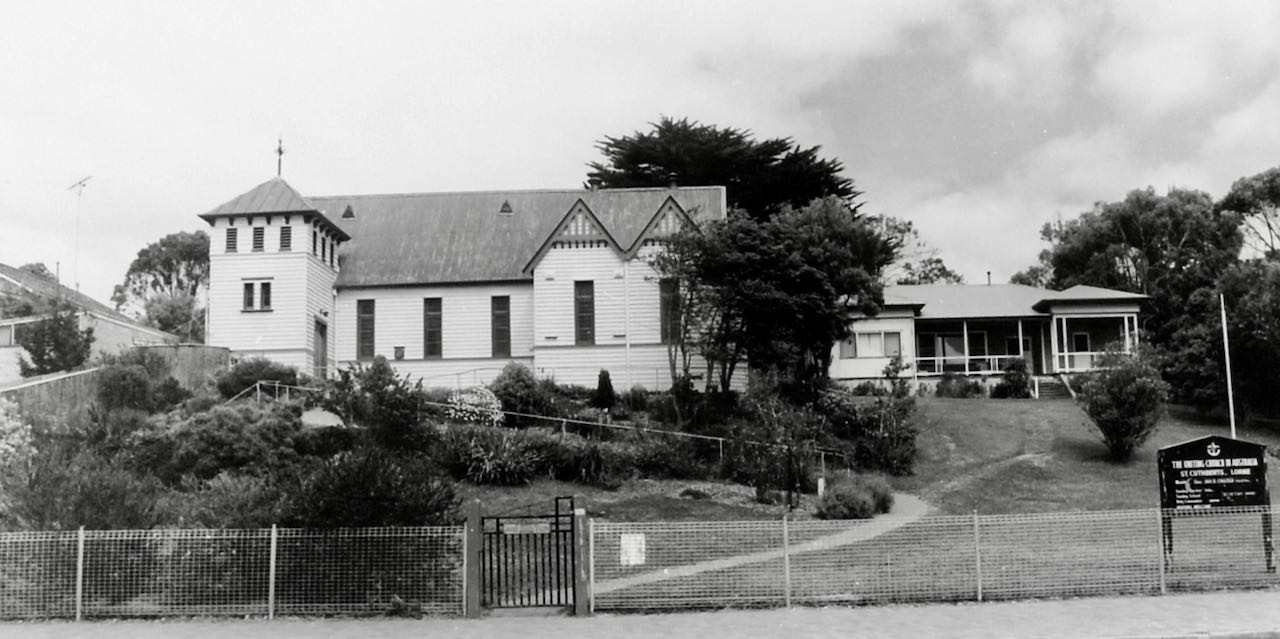
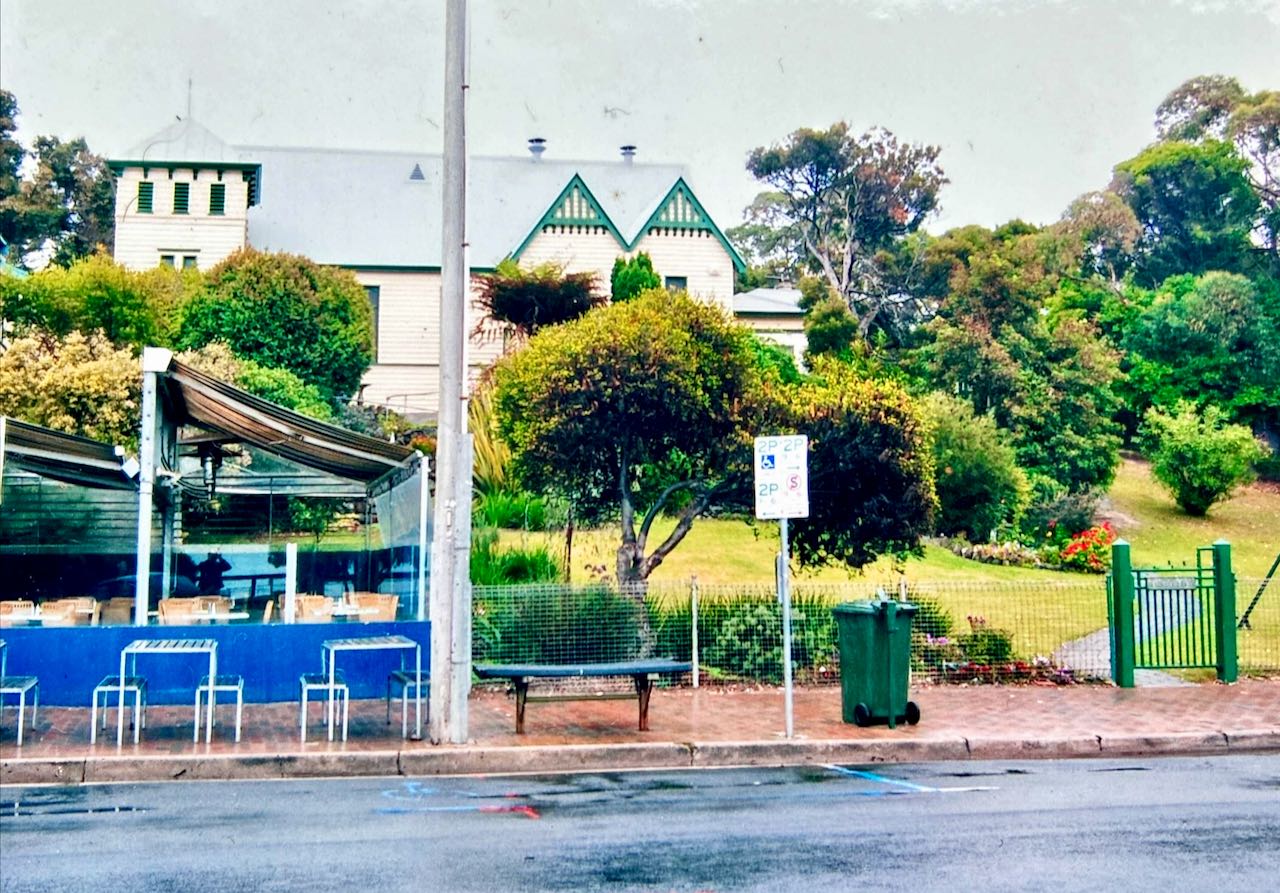
It was built by Andrew Sanger, a Scottish born cabinet maker and builder. Described as an attractive timber church in the picturesque manner, displaying quaint sub-literate Gothic detailing such as drip mould on the internal walls; a miniature splayed apse and a quasi-Italianate tower. Arts and Craft influences can be seen in the open work strapping of the gables and contrasting timbers of the handsome boarded interior.
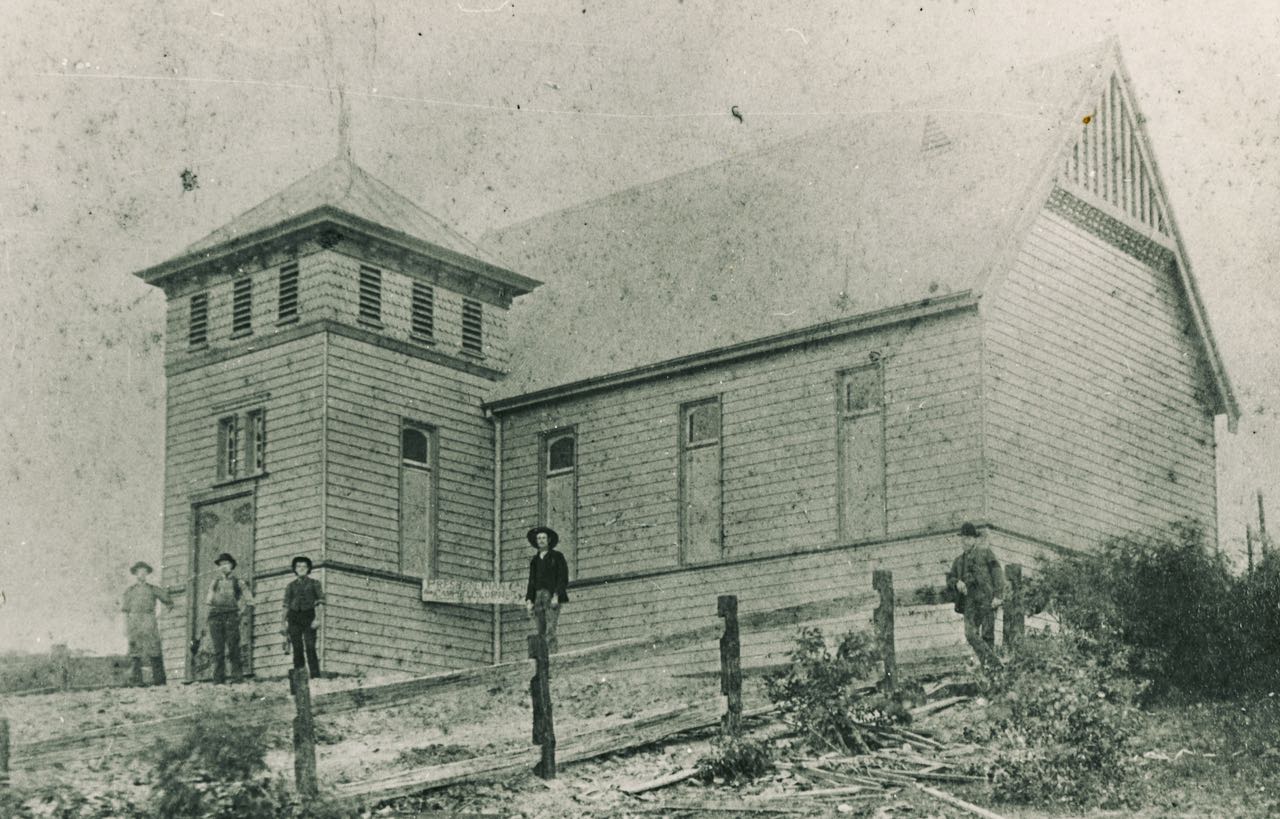
1892, Presbyterian Church. (LHS photo 1613)
In the 1950s the large Lamberta pines around the property were making a shady dismal atmosphere and were cut down.
In 1997 St Cuthberts became the Uniting Church. Behind the Church is the Sunday School hall. In the 1960s and 1970s as many as 35 pupils attended the Sunday School.

-
- St Cuthberts Church (Photo LHS 2342)
-
- St Cuthberts Church, (LHS photo)
-
- 1985, St Cuthberts
-
- 2009, St Cuthberts
Some Donations
- Windows in the pulpit area are the gift of the Boyd family.
- Pulpit is the gift of the Buick family.
- Hymns board in memory of Miss Agnes Smith
- Communion table and chairs given by Mrs Andrew Harper.
- Pulpit chair is gift of Mrs Andrew Harper
- Pulpit bible gift of Rev. Alexander Skene.
- Picture in Vestry of a Scottish session is a gift Rev. J. Aitken.
HISTORICAL ACCOUNT OF ST-CUTHBERTS PARISH LORNE
From the beginning until 1978.
Written by Reverend S A Goddard A pril 1978.
St Cuthberts Uniting Church is the result of the loyalty and faith of early Christian residents in Lorne, the supporting interest of visitors who enjoyed the holiday attractions of the place, and the initiative and guiding hand of the Presbytery of Geelong, a Court of the Presbyterian Church of Victoria. References in the minutes of Presbytery and Assembly though lacking in detail, indicate the growing awareness of Lorne’s attractiveness and development as “A summer watering place”, its possibilities and needs, and the challenge to establish a centre of Presbyterian Worship.
The first reference in the minutes of Presbytery concerning this isolated settlement appeared in 1882 as the consequence of a report from a committee appointed to enquire into the needs of districts within the bounds of Presbytery without Presbyterian Services of Worship, affirming that Lorne would be a suitable place for holding such Services. The Home Mission Committee was asked for a grant to enable this to be done.
By the eighties Lorne was establishing itself as an appealing resort with its coastline and bush, its streams and hills, its flora and fauna, and the opportunities for fishing and walking. The town area, once a venue for timber cutters and part of a pastoral run, had been surveyed and freehold land sold, a jetty for the transport of timber and passengers had been built, the Mountjoy’s had established Erskine House for the entertainment of visitors, the Lorne Hotel was operating, and the Grand Pacific Hotel under construction, coaches from the wide plains beyond crossed the ridge over Benwerrin in what often appeared a hair raising adventure. The State School had been built and the town was taking shape. During the eighties visiting Ministers of religion occasionally called, and held Services in a picturesque and wide rocky area of the Erskine River which came to be known as the Sanctuary.
The Church of England then became established, the first Church building in Lorne, and in a new area of goodwill often provided for people of other denominations, this co-operative spirit again being manifested in 1977 when St Cuthberts Church gave a financial donation to the Anglican Church to help in the expensive job of reblocking the building.
Again in 1885 a more pressing request for Presbyterian Services at Lorne was made by Reverend Alexander Stewart of the Leigh, who at Presbytery’s request visited Lorne, and returned with the recommendation that a site be procured for a Church and a committee appointed to initiate services. This action was approved, together with a resolution of thanks to the gentleman who drove Mr Stewart to Lorne, no mean feat in those days. The committee comprised Reverend’s A Stewart, D A McDougall of St Georges, and Elder N McCallum of St Georges.
However the practical difficulties of distance, finance and manpower were not easily overcome, and a further three years passed before Reverend C Robertson of Barrabool, reporting on behalf of the Otway Forest Mission Committee recommended the purchase of a site for a Church at Lorne at an estimated cost of £160, and the lodging of an application with the sites fund committee for a grant of £75, towards cost. This was warmly approved.
The Assembly Minutes of November 1888 report an application through the Presbytery of Geelong for a grant of £75 towards the purchase of a site at Lorne of 40 feet frontage for £160 and record approval.
The following year the Presbytery appointed four trustees for the property being acquired, namely Mr John Stirling, a grocer and resident of Lorne, Mr Andrew Harper of Toorak whose occupation was given as “gentleman”.
However he had been principal of the Presbyterian Ladies College, East Melbourne, later being appointed Professor of Hebrew and Old Testament studies at the Theological Hall, Ormond College and in 1902 becoming Principal of St Andrews College within the University of Sydney, where he remained until retirement in 1921. Mr Charles Shannon of West Beach, a banker. The names of these four men appear on the Certificate of Title for the original site of 40 feet in Marine Parade, now Mountjoy Parade, and with a depth of 132 feet.
The names of these four trustees are symptomatic of the fact that the establishment and direction of the Church was the work of local residents together with people from Melbourne and the Western District who holidayed at Lorne, and appreciated for others and themselves the opportunity to worship in keeping with Presbyterian custom. Among the visitors who gave a lead in the Church life at Lorne were people in educational, business of landed pursuits who were able to enjoy a holiday of sufficient length to make the arduous journey worthwhile. Also in that more sabbatarian age some felt that a holiday home should be far enough away not to tempt frequent short visits which interrupted the regular Church and family routine.
The Stirling name is still represented in the grandson of the first trustee, Mr Douglas Stirling, an Elder and Sunday School Superintendent, and the Harper name often appeared during developmental stages in members of the Harper family who owned the house adjacent to the present hospital now occupied by the Medical Practitioner.
The land in Marine Parade from Grove Road to the southern boundary of the Church site comprised the original Crown allotment 1, with a frontage of 100 links, and 40 feet of lot 3, also of 100 links frontage, and each bounded in the west by Smith Street.
At the original sale of this Crown land on 25th June 1878 lot 1 was sold to Frederick Orchard, a butcher, and lots 2 and 3 to William Matthews a butcher of Geelong. The purchase price of lot 2 is recorded as £17-10. in March 1884 lot 1 was transferred to James Hendy, an agent, lots 2 and 3 in February 1888 went to Robert Gosney of Winchelsea, a Shire official. Lots 1, 2 and 3 were soon afterwards bought by James Campbell of St Kilda who in January 1890 sold a portion of lot 3 to the Presbyterian Church. In February of that year Arthur Farr, a contractor of Melbourne purchased the balance of lot 3, lot 2 and part of lot 1. After the transfer of a small part of Arthur Farr’s land to Edgar Mountjoy, on May 20th 1904, all the balance of Arthur Farr’s land was purchased by James Buick, this being Crown allotments 2 and parts of 1 and 3. All this land Mr Buick transferred to the Presbyterian Church on 25th May 1908 for the sum of £164. This enabled the Church site to be continued through to Smith Street, making a substantial piece of land for the future provision of Manse and Hall and any other purpose which the Church may desire. When we remember that the original small portion of Crown allotment 3, 40 feet by 132 feet cost £60, the purchase from Mr Buick was exceptionally generous, and the Congregation is much indebted to his generosity and foresight.
James Buick arrived in Melbourne from Scotland in 1848, and established business interests in Adelaide, Bendigo, and later Melbourne. He was a generous supporter of the Church in Lorne, and members of his family continue this loyal support. His family is represented today by his grandaughter Miss Margaret Cunningham, whose Lorne residence “Ravenswood” was the home of Mr Buick.
The acquisition of this land was a wonderful answer to the Church’s needs, for in April 1907 Reverend J McNair reported to Presbytery that it was advisable to purchase land adjoining the Church property for future requirements.
Presbytery thereupon appointed a committee comprising Reverend’s A L Houston, J A Forrest, J McKenzie and J V McNair to consider ways and means of achieving this goal. The task was made easy and successful by the action of Mr Buick.
Having secured the original small parcel of land in November 1891, Presbytery accepted a tender of £175 for the erection of a Church building thereon, with Mr Andrew Sanger being the successful tenderer. Mr Sanger had served his time as a cabinet maker in Scotland, and on coming to Australia and residing in Lorne accepted work as a builder. His skill with wood is reflected in the choice of imported pine for the interior, the ornamental and tasteful timbered shapes, and the external open ended strappings on the gables. The opportunity for using such imported timbers in a timber producing area was made possible by the custom of ships coming to Australia for wool bringing with them timber for ballast.
The Church was rectangular in shape, with the front door opening to the east, and with the pulpit and organ on a slightly raised dais in the south west corner. About 1911 the transepts and present pulpit area were added, giving the building a much more interesting and open appearance within, and using the historic and symbolic shape of the cross. This arrangement transferred the pulpit to the north and about forty years later the original dais was removed.
Presbytery Minutes reveal that in 1916 Reverend J A Forrest requested permission for certain innovations to be made to the building as a consequence the Vestry was built by Mr Sanger in 1918, his labour provided free of cost. The erection of the additions as well as the original structure by the same person has meant that allparts of the edifice are in keeping with each other, creating a unified and harmonious whole. The dedicated workmanship of Mr Andrew Sanger was recognised in 1975 with the classification of the Church by the National Trust. An anonymous donor gave a plaque to indicate this, and in January 1976 this was placed on the external eastern wall and unveiled by Miss Monica Stark of the National Trust.
During the last century and the early years of this one, rectangular weatherboard Churches were dotted all over the Australian landscape but few are to be found with the tasteful structure of St Cuthberts.
The citation supporting the classification describes St Cuthberts as “A pleasing timber Church of 1892 with open work strapping in the gables and a handsome boarded interior”. The name of St Cuthberts Lorne now appears in the official list of our National heritage.
The Church has benefitted from many gifts of furnishings from individuals local and visiting and in one case from a congregation, Ewing Memorial East Malvern which gave the Communion Chalice. Some gifts are memorials with names inscribed. The fine windows in the pulpit area are the gift of the Boyd family, in memory of Mrs J Boyd.
The Pulpit is the gift of the Buick family in memory of Mrs James Buick. The Hymn Board is in memory of Miss Agnes Smith, who gave nursing help in the district and whose name is recorded above the gate into the grounds.
The Communion Table and chairs were given by Mrs Andrew Harper in appreciation of Dr Robert Rain and the church he served, whose photo in moderatorial robes is in the Vestry. Dr Rain was Principal of the Theological College of the Free Church of Scotland, one of the Free Church’s greatest leaders, three times a moderator, a relative of the Honourable James Balfour M.L.C. and of the Harper family, and who visited Melbourne in 1889 invited by the Presbyterian Church of Victoria to attend the Jubilee Celebrations of 50 years of Presbyterianism in Victoria. The Pulpit Chair is the gift of Mrs Andrew Harper in thanksgiving for the safe return of her sons from the First War, the Pulpit Bible the gift of Reverend Professor Alexander Skene, and the picture in the Vestry of a Scottish Session at the ordination of an Elder the gift of Reverend J Aitken.
The Church building thus established has been well maintained and modernised in keeping with changing needs and times. Gas lights gave way to electric. In 1960 the church was rewired, and later the organ was electrified, a fluorescent light was placed behind the Cross, strip heaters and fire extinguishers were included. In 1968 the Church was reblocked. Later the dais in the Pulpit area was enlarged and carpeted, the pews sanded and oiled, the roof painted, and concrete paths extended around the Church, and with steps leading down to it from the hall area.
Two other important gifts came to Lorne for Church use. In 1891 Miss Hastie of Toorak gave acres of land in Charles Street as a site for the erection of a sanatorium for Presbyterian Ministers needing a rest. The Assembly instructed the Presbytery to raise funds to carry out the purpose of the gift and to frame rules for the management of the institution. As the years went by the project lost its appeal and in 1958 the Assembly permitted the sale of this land and the use of the proceeds for the erection of St Cuthberts hall. Thus the long past generousity of Miss Hastie enabled the building of a useful hall. Miss Hastie was a member of the family of Mr John Hastie of Corangamite who left substantial bequests on trust to the Presbyterian Church and the University of Melbourne.
The second generous gift came from Miss Margaret Dennis whose family circle were landed pioneers and who had a long association with Lorne. In 1957 she presented to the Presbyterian Church her home “Weeloo” at 248 Mountjoy Parade as a holiday home primarily for missionaries on furlough and for ministers. The property extended through to Smith Street, the rear portion of land was subdivided into two blocks, which were sold, the proceeds of the sale being used to divide the home into two flats, the property has been managed by the Presbytery.
Subsequent to the building of the Church, Services were held in the holiday season by visiting ministers. The names of Dr A Harper and Dr Rentoul appeared often. As they were engaged in theological teaching and not parish work they were able to stay for longer periods. Later still among the visiting preachers Reverend’s Irving Davidson, Graham Balfour, Frank Rollard, Frank Paton, T J Smith, Dr W Borland and Dr J McKenzie. There was a good community spirit between Presbyterians and Anglicans, and in the winter months Presbyterians attended the Church of England, and their children participated in the Sunday School of that Church.
In the holiday months Mrs Sanger, Miss Buick, Mrs Westerton and Mrs Campbell visited hotels and guest houses, advertising services and preachers, and inviting the help of any choristers, often resulting in the assistance of a good choir. A summer bazaar and tennis tournament brought people together in fellowship and raised money for Church maintenance. The annual bazaar was a big event, held either in the garden of Ravenswood or in the Library Hall. Visitors brought with them boxes of goods. The local people had a room full of prepared articles. The Anglican people helped and immediately afterwards people were thinking about next years effort.
In these ways worship was maintained, the property cared for, fellowship within the Church enjoyed, and Christian Witness given in a tourist area. The First World War changed this pattern to some extent in that such moneyraising efforts were held in aid of the Red Cross and war projects.
On January 30th 1915 a local church committee was elected comprising Reverend’s I J Smith, Professor A Skene, Mr Matthews, Mrs Harper, Mrs Sanger and Miss Shugg, with Mrs Harper Secretary and Mrs Sanger Treasurer. This committee continued to meet at regular intervals to deal with finance and all matters of congregational life. Its first resolution was to ask Mr Campbell, Curator of Colac Botanical Gardens to lay out the Church grounds. This was done at a cost of £12-10s.
The great dream of the twenties was the erection of the Manse, and this goal was brought even closer by faithful people who organised fetes, held tennis tournaments on the flat, and saved and planned. In this visitors and local residents equally participated. 1927 was the year for action. The Church Committee was divided into two parts one local and one external, the latter meeting in Melbourne. Mrs Sanger was convenor of the local, and Mr W G Balfour Secretary of the other. Any matters concerning the building of the Manse required the approval of both sections through correspondence. Reverend G Balfour was empowered at any time to deputise for the Interim Moderator. He and Mr W G Balfour were sons of the Honourable James Balfour M.L.C. a leading churchman politician, and business man in Victoria of the last century.
Reverend Graham Balfour planned a holiday home in Smith Street which is still used by his daughters and grandchildren, one of who Mrs John Almond together with her husband are frequent worshippers at St Cuthberts. Today plans for the Manse were suggested by Mr R Dennis and finally placed in the hands of Messrs Laird and Buchan, Architects of Geelong. The cost was £1885, £1949 with architects fees, leaving the congregation £200 short in payment. This amount was loaned by Miss Buick free of interest.
Mrs John McKenzie of Toorak and Mrs Carr of Geelong made arrangements for the furnishing of the manse, an extensive number of household items and donations being contributed. The foundation stone, the gift of Mr & Mrs W G Balfour, was laid on the 23rd January 1928 by Miss Margaret Buick and the building opened on the 8th April by Mrs Andrew Sanger wife of the builder of the Church and Daughter of Mr John Stirling. These women were leaders in the enterprise that brought the manse into being and it is fitting that their names should be inscribed on its walls.
After the opening ceremony tennis tournaments were held with trophies donated. Socialites brought the day to a close with the expectation of providing for a dependable holiday ministry to the Church and a holiday home for ministers.
These twin objectives were well met, for the visitors book tells the story of happy holidays for ministers and a variety of preachers for service. Many a minister remembers the friendly welcome and help given to him by Mrs Sanger on his arrival. Ministers were originally asked to pay £1 weekly for the use of the Manse in the summer and 10/- in the winter.
In addition to being a home for visiting ministers it has since been occupied by successive duly appointed ministers of the parish. It has been well maintained and kept up to date. The wood stove has given way to gas, the open fire to oil heating, linoleum to carpet and copper and troughs to stainless steel sink. Additions have been an electric hot water system, insulation above the ceiling, a sun room on part of the verandah, new cupboards, and concrete flags and paths outside. A doorway and kitchen hatch were sealed, and a more convenient doorway cut from the dining room into the kitchen. In much of this modernising process both labour and materials were donated. At the same time ordinary wear and tear has been well handled with the result that at the Jubilee Celebration of the Manse on April 8th 1978 a well kept building was still in use.
The next major building enterprise was the hall. This involved the sale of land in Charles Street and the raising of a loan. For this purpose local trustees were appointed in 1957 namely Messrs P Hunt, D Stirling, L Jarratt, P Murray and E Frost. Plans were prepared by J Gordon Williams Architect of Geelong, and in 1960 the tender of Jackson & Cook for £4900 was accepted. The building was dedicated on 3rd September 1961 by the Moderator of Presbytery Reverend D W Matthews. It has proved a most useful and attractive, adjunct for Sunday School Classes. Group meetings, public occasions, and is often used by the local school and other community enterprises, thereby providing a useful avenue of service.
In 1976 the hall was divided by a ceiling to floor partition, a year later a movable platform was built, the latter needed for concert entertainment and the former to enable kindergarten and senior Sunday School children to meet at the same time. Mr Reg Briggs assisted by others created these extensive improvements.
In the grounds outside trees were planted, and a concrete path added between hall and gate. The extensive grounds have been kept in order with drainage, the planting of trees and shrubs, the fencing of the manse rear garden, the original enclosing of the grounds with a picket fence, and its later replacement by a strong cyclone fence through the generousity of Mr & Mrs McNeill, the regular payment by Miss Kininmonth for cutting the grass and later provision of a good mower by the ladies guild.
Lorne’s isolation as a separate community together with the large influx of visitors at holiday times have made a Ministry and healthy congregational life important, but the small number of permanent residents have made this difficult. From the late thirties attempts other than relying solely on holiday ministers have been made.
In March 1938 Lorne became part of the western patrol, and Communion Services were regularly held by the patrol Padre Reverend D M K Jones, who maintained nineteen preaching centres centred about Lorne, Apollo Bay, Port Campbell, South Timboon and Laang. He was succeeded by Reverend G Nathan. These ministers were assisted by Home Church Mission students, two of whom Charles MacLeod and David Forbes were appreciated in Lorne, and later became Ministers.
On September 6th 1944, Reverend H C Wilson was inducted into the newly formed pastoral change of Lorne. Standing on its feet as an independant Parish the congregation elected its first Session comprising J W Read, A S Fyffe, N G McDonald and P Hunt, Session Clerk. In March 1948, Mr Wilson accepted a call to Bulla, and in the following May Reverend S A Vertigan was inducted, but resigned soon afterwards owing to the ill health of his wife.
Thereafter again a succession of ministers occupied the manse for holidays taking services while in residence. In 1953 Lorne was combined with Apollo Bay, with Mr Buchanan as Home Missionary. He resided at Apollo Bay, but with the building of a sunroom he was able to retain a small area of the manse for himself whilst holidaying ministers could use the remainder and assist with services. During these years when Lorne ceased being an Independant Charge it received the help of good Moderators such as Reverend A McK Harrison, E New and A Yule.
In 1960 Reverend Michael Owen was inducted and remained until 1963 when he left to become a theological lecturer in Perth. For sometime previously he had been a post graduate student in Germany.
In August 1963 Reverend Arthur Lewis was inducted. For long years he had been a Baptist Minister, serving latterly as Minister of the Collins Street Baptist Church Melbourne.
On being received on his application into the Presbyterian Ministry he was appointed Minister to Lorne. In virtue of his Melbourne activities he was well known as a Preacher, and many visitors were glad of his leadership in worship. He left for Geelong in 1967. Reverend J Aitken followed in 1968 remaining until 1973. He had behind him a fine record of Ministry, having been Moderator of the Western Australian Assembly, and for long years Minister of St Andrews Bendigo. During his years at Lorne the Parish was consolidated and strengthened and many improvements were made to the Manse, the Church and grounds. At times his health was not good, and in the end he resigned, because of this, leaving the charge in good heart.
In July 1973 Reverend S A Goddard followed. He came from the Ewing Memorial Church East Malvern, thereby renewing the links with that Congregation established in earlier days by its Minister Reverend T J Smith and its gift of the Communion Chalice.
On 22nd June 1977 the Uniting Church in Australia was formed from the Union of the Congregational, Methodist and Presbyterian denominations, and St Cuthberts became a congregation within it. On the following Sunday June 26th. The first Parish Meeting was held and the First Parish Council elected, Mr L Jarratt became the First Secretary of the Parish Council, and Mr R Hewitt the first Treasurer. Mr L Jarratt having served in an excellent capacity as Session Clerk for a long period, being only the Second Session Clerk in the history of St Cuthberts, acted as Secretary to the Council of Elders. He and Mr H Wettenhall were elected representatives to the Barwon Presbytery.
Throughout its history the Church has been notable for generous gifts and voluntary labour. Self help has been the motto, and members and visitors have responded. This is seen in the furnishings of the Church, and the long list of household goods and donations for the Manse. This spirit has continued with the result that already in 1978 an overhead projector has been presented by Mr & Mrs H Wettenhall, a screen by Mr & Mrs D Stirling, and a supply of the New Australian Hymn book was initiated by a joint gift from Mr & Mrs Briggs and Mr & Mrs Wettenhall with the Ladies Guild paying the remainder. About three years earlier to help the regular income an anonymous donor gave $1000 in 10% bonds. These are symptomatic of numerous gifts received.
Gifts of labour have enabled many maintenance jobs to be done without cost. Painting and repairing buildings, mending water pipes, laying concrete, altering buildings, repairing roofs, installing lights, cleaning grounds, committee records bear witness to an endless stream of voluntary labour. Building maintenance and improvements have been helped by people of practical skills, such as Mr D Stirling, an Electrician, Mr Lyn Jarratt, with Electronic and Photographic skills, Mr R Bell a retired bricklayer, Mr R Briggs a retired builder, Mr V Grose a mechanic, Mr L Hughes a retired timber proprietor and Mr R Dennis, Mr A McNeill, Mr O Bannister, Mr H Wettenhall retired farmers. The list is far from exhaustive, but is indicative of the skills that have been used for the benefit of the church.
The Congregation has always been a centre of Fellowship and service. The Ladies Guild has raised large sums for maintenance and good enterprises. An annual street stall and a stall within the grounds have been successful. Add to this concerts, social gatherings, providing food for special occasions, a craft exhibition, cleaning the church and floral decorations and any other pieces of needed help, and the Guild’s important roll stands out.
The Women’s Missionary Union has been equally active in the study of Mission enterprises and their support with prayer and finance.
Since the formation of the Uniting Church these two groups are part of the Uniting Church Fellowship. Other groups have come and gone according to need and availability of leaders and personnel. In 1956 Mrs James led a girls club. After a long lapse this was recommenced in 1976. For a time there was a P.F.A. and a women’s evening fellowship. A craft group commenced in 1977. In the early forties Mrs Foster led a young worshippers league. From time to time bible groups have been held.
The Sunday School has gone through changes, but has continued with faithful leadership. It has met separately or it has met with the church separating later for classes, and has long had a pattern of a picnic, anniversary and prize giving. Kindergarten and older classes have met separately, the latter for a time in the local school building, returning to the hall on its division by partition. Here again generosity has provided prizes and parties.
The Congregation has been aware of the needs of others. Mission requirements through the budget, the Christmas Bowl, the Geelong Hospital Chaplain, religious instructions in schools, these and similar claims have been answered. At times the Church has looked beyond itself to see if Service could be held in neighbouring areas. In the forties Services were held at the Wye River. In the sixties Reverend M Owen held a Communion Service in the Church of England at Aireys Inlet, and Services and Sunday School were held at the Kennett River. At its meeting in August 1962 the session raised the possibility of acquiring land at Aireys Inlet and Wye River. This suggestion was not further continued, and the Services lapsed.
Fraternal relations with the Church of England and Catholic Church have been good. They co-operate for the Womens World Day of Prayer, and together raised substantial monies to help in building the units for Senior Citizens, a project of the Lions Club.
At times services have been helped by the temporary arrangements of a choir. The leadership of Mrs L Hughes assisted with the playing of Mrs A McNeill created a fine singing group assisting in Services, providing choral items for special occasions, producing concerts, visiting other places, and in 1978 taking the name of the Melody Makers. In 1978 the Congregation of St Cuthberts faces the future in good heart, seeking to maintain a living Christian Witness in a changing age.
The permanent congregation is small in numbers but strong in the desire to serve and contribute time skill and money. Around this nucleus a good number of visitors gather for Worship, holiday house owners, campers and motel dwellers, conference groups, Senior Citizen’s groups, and youth groups enabling the church to be a living centre of Christian Worship and an influence beyond the bounds of Lorne. As part of the Uniting Church it seeks to fulfil its mission and leaves to Almighty God the results of its efforts and the days ahead.
OFFICE BEARERS.
The following are recorded as having served in the specified offices of St Cuthberts Church. The list cannot be exhaustive because all records are not complete, and it is often not possible to ascertain initials.
SESSION CLERK.
Mr Philip Hunt 1944-65. Mr Lyn Jarratt 1965-77.
ELDERS.
Messrs P Hunt, E Frost, N J McDonald, J Read, A S Fyffe, S Hayes, P Murray, R L Dennis, L Jarratt, H Wettenhall, R Bell, D Stirling, O Bannister, R Briggs, R Hewitt.
SECRETARY TO THE CHURCH COMMITTEE OR BOARD OF MANAGEMENT.
Mrs A Harper, Mr C M Craigie, Mr Heatherwick, Mr Smyth, Mr H Hammerton, Mrs O Bannister, Mr Clive Tune, Mr L Jarratt, Mrs M Hunt, Mr Wettenhall, Miss R Wilson.
REPRESENT A TIVES TO PRESBYTERY.
Mr O V Bannister, Mr R Bell, Mr H Wettenhall.
TREASURER.
Messrs P Murray, D Crossby, J Hay, E Callaghan, J Schmidt, R Hewitt. Mesdames Sanger, H Hammerton, L Jarratt.
ORGANISTS.
Miss M Buick, Miss A Beal, Mrs H Hammerton, Mrs N Floate, Mr John Osborne, Mrs A McNeill.
SUNDAY SCHOOL S U P E R I N T E N D E N T S.
Mrs A Sanger, Mrs H Hammerton, Mrs L Drayton, Mr D Stirling.
KINDERGARTEN LEADERS.
Mrs Foster, Mrs L S Jarratt, Mrs J Schmidt, Miss Pamela Tank, Miss Val Tank.
UNITING CHURCH OFFICE BEARERS.
COUNCIL OF ELDERS.
Mr L S Jarratt Secretary, Messrs O Bannister, R Briggs, R Hewitt, D Stirling, H Wettenhall.
PARISH COUNCIL.
Secretary – Mr L S Jarratt.
Assistant – Secretary – Miss R Wilson.
Treasurer – Mr R Hewitt – Resigned 1978. Mr L Hughes.
Assistant Treasurer – Mr R Hewitt.
Sunday School Superintendent Mr D Stirling, (Miss Valda Tank Kindergarten)
Organist – Mrs A McNeill.
Representatives to Presbytery of Barwon – Mr L S Jarratt, Mr H W ettenhall. Uniting Church Fellowship.
President – Mrs S A Goddard.
Secretaries – Mrs V Grose and Mrs R Holmes.
Treasurer – Mrs R Allen.
Girls Club – Miss Valda Tank.
Choir and Melody Makers – Mrs L S Hughes.
ADDITIONAL INFORMATION PERTAINING TO THE LORNE PRESBYTERIAN CHURCH
October 18th 1912 Bell L Sanger (Isabella Lauder) Presbyterian Church Building Fund (Power to Operate) Wife of A F W Sanger builder Lorne.
January 11th 1917 Bell L Sanger (Isabella Lauder) Lorne Presbyterian Church Collections Fund.
July 30th 1937 Mrs Florence Martha Craigie (Wife of Postmaster) St Cuthberts Ladies Guild
The Lorne Presbyterian Church Building Account
4-6-1948 Hugh Nicholson Smyth (Secretary) (Headmaster)
Wilhemina Morris (Assistant Secretary)
November 15th 1963 St Cuthberts Ladies Guild Grounds Account Verna M Floate – Mrs R A Alien (Win) – E G Owen
Poems by Reg Briggs March 1976 and possibly printed in the Lorne News.
St Cuthberts the Church on the Hill, An Appreciation of Lorne
Sources:
- Lorne Historical Society Collections
- Doug Stirling recollections
- Account written by Rev S. A. Goddard, April 1978.

