
Lorne Aboriginal Heritage
The Indigenous custodians of the land that makes up the Otway Ranges is believed to be the Gadubanud people. Their connection to land stretches back thousands of years as evidenced by the aboriginal middens around Lorne.
The Gadubanud people occupied the rainforest plateau and rugged coastline of Cape Otway covering the present towns of Lorne and Apollo Bay.
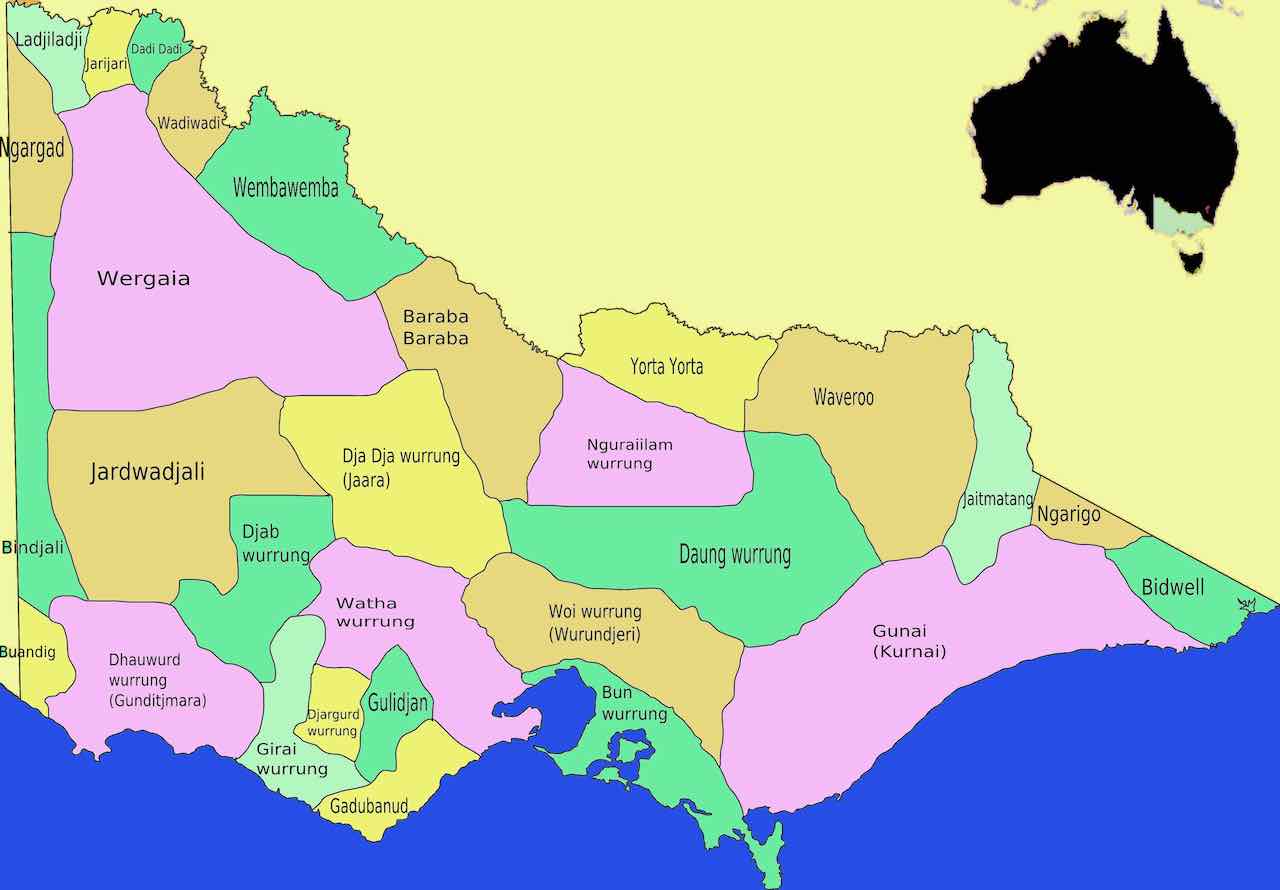
By Tirin aka Takver – Own work, CC BY-SA 3.0, https://commons.wikimedia.org/w/index.php?curid=5541910
Indigenous History of the Otways¹
Aboriginal people have always lived in Victoria, scientifically dated now to 65,000 plus years. The Gadubanud (Katabanut) people have occupied the rainforest, estuaries, grass and wetlands, and coastline of the Otways for hundreds of generations.
Local rivers and their estuaries such as the Painkalac and Gellibrand with natural changes in Country lead to changes in Culture and Language; moving through Gadubanud Country from Koala to King Parrot speaking.
The Gadubanud successfully avoided much contact with European settlers prior to the 1830s, which led to the belief that the Otways were uninhabited.There are stories passed down by Gadubanud descendants, of woman being removed prior to colonisation, and instances of violent clashes with early whalers and sealers.
The Gadubanud lived a mostly peaceful life, though occasional clashes with other tribes gave them a feared reputation as being “wild”. They traded spear wood for Mt William greenstone when tribes from across Victoria met for traditional ceremonies e.g. at Mt Noorat, Mt Napier and Gariwerd.
Abundant middens found around the Otways show that Gadubanud people had an abundant and rich diet ranging from fish and shellfish to seal, eel and duck. Animal protein also came from marsupials, snakes, lizards, frogs, birds and possums. In addition to possum meat, hides were also used to make cloaks for protection from the elements. Kangaroos and wallabies were used in the same way. Plants were also a mainstay of local diets, medicines and tools.
Along the coast, Bauer spinach, numerous berries, and a wide variety of herbs were also readily available for perfect recipes rich in proteins such as eel and mutton bird. The most widely consumed starchy foods included the roots of yam daisies, a range of tubers, and grass seeds. Yam daisies were cultivated annually; mostly involving careful ‘separation and replanting’—not unlike gathering bulbs from orchids; and could even incorporate fire.
Burning practices were highly utilitarian, e.g. using fire to release scarce nutrients into the soil to promote regeneration and the continuity of a mosaic of native ‘pasture’ around parts of the Otway’s. This not only actively promoted longer-term consistency in numbers of macropods for sustenance, and more permanent hunting locations for generations, but it also easier access to this networked mosaic.
As diligent farmers know, doing ‘a bit of maintenance often is better than having to put in a huge effort occasionally’. Regularly walking the walkpaths of their Country, was what kept the Otway coastal and hinterlands readily accessible for Gadubanud people. One of the earliest official European recording of the Gadubanud people was in 1842 by Chief Protector Robinson at the mouth of the Hopkins River at Allandale near Warrnambool.
Other early official recordings come from the logs of passing ships. Historical records show that interaction continued between European settlers and the Gadubanud people long after 1846, despite typical frontier myth-making of the time, stating that Gadubanud have all died. During this time period, massacres and violent clashes between settlers and tribes took place all over Victoria, including the Otways. Notably the most significant massacres affecting the Gadubanud include the ‘Aire River massacre’, one of several in this serene green valley. It is known that surviving Gadubanud people joined other tribes at the Wesleyan Buntingdale Mission near Birregurra, or sought protection to the west at Tooram station with relatives. Survival saw frequent movements between different missions, and semi-independence on stations around Colac. Descendants of the Gadubanud survivors continue to live in the Otways to this day.
Sources:
- “Aboriginal Languages and Clans: An Historical Atlas of Western and Central Victoria, 1800-1900” by Ian D. Clark
- King Parrot Cottages website: https://kingparrot.com.au/gadubanud-the-king-parrot-people/
- ¹Indigenous History of the Otways – Qii House Lorne
Before Loutitt Bay
Gadubanud lands Niewojt 2009 It is hard in the twenty first century to agree on ‘the facts’ about life in what is called the Otways before the arrival of Europeans, and during the period after 1835 when British sovereignty was introduced. Very little evidence today exists in the public arena to say precisely how life was for the...Read more
Middens
A midden is a sacred site for Aboriginal people, as it represents a site where ancestors gathered to eat and cook the shellfish and seafood available along the coast. There is a midden near the South end of the old Coop building at Point Grey and another is about opposite the hospital on the foreshore...Read more
The Gadubanud
The Gadubanoot The Otway First Peoples were the Gadubanud (or Katubanut), though Pascoe has used the spelling “Gadubanoot’. As his version reflects the verbal pronunciation, I have therefore chosen to honour it through this story. Opinion does also question the correct pronunciation, but most seem to place phonetic emphasis on the last syllable, pronouncing it...Read more

