
Lorne, Victoria, Australia
The Reverend Leslie Wallace Bull (1899–1998) was Vicar jointly of All Saints Church Lorne and St Aidan’s Aireys inlet from 1969 to 1979. He had been ordained priest in 1924 at Port Pirie in South Australia, initially serving in various parishes between Whyalla and Port Lincoln. In 1929 he transferred to the diocese of Wangaratta where he was rector of Nathalia (1929–33) and Beechworth (1933–40) and in 1940 he came to the diocese of Melbourne as vicar of Mount Dandenong and Olinda where he remained until 1949, when he was appointed vicar of St Nicholas’s Mordialloc and St Columba’s Edithvale.
A talented organist and an excellent singer he built up a very successful children’s choir at St Nicholas’s and sometimes, in periods when there was no regular organist, dashed between altar, pulpit and organ. In his early years at Mordialloc he had no car but cycled around the parish and, on Sunday mornings, between services in Mordialloc and Edithvale. His arrival at Mordialloc coincided with a significant post-war housing development in the back areas of the suburb where he extensively door knocked, not to proselytise but to make new residents feel welcome and to familiarise them with local institutions, including the church.
While always appreciative of diversity in Anglicanism, and respectful of the intellectual tradition in the evangelical wing, he identified himself with the Anglo-Catholic tradition. In line with this he made a big commitment to enhancing the fabric and lay-out of St Nicholas’s Church. He had a great interest in the visual arts and in architecture. He established a long-term friendship with Louis Williams, the architect who designed St Nicholas Church, and commissioned a work of art that was hung in the chancel of the church. He also engaged the renowned ecclesiastical needlework artist Mrs Parnell Bruce, who had also made the St Nicholas Church banner, to make a set of eucharistic vestments. An article on her, with a photo of him, was featured in the Woman’s Day for 11 February 1952.
Leslie Bull grew up in Williamstown, the son of the foreman of the Williamstown Dockyard. His first job was in the Melbourne G.P.O. in Spencer Street where his performance was so exemplary that he was transferred to Government House as messenger between the Governor-General and the Prime Minister, Melbourne then being the interim capital of the Commonwealth. At Government House he caught the attention of the Dean of Melbourne, John Stephen Hart, who began teaching him Latin and encouraged him to pursue theological studies, helping him to secure a place at St Barnabas Theological College in Adelaide. His studentship was funded by the diocese of Willochra in South Australia’s north—the diocese for which he worked for the first five years of his ministry.
In 1968 Archbishop Frank Woods offered him the parish of Lorne as a partial retirement position. Leslie understood that it included St Aidan’s, Airey’s Inlet, but it was only after he had accepted the position that he discovered he was also responsible for St Paul’s Deans Marsh. His Sundays therefore involved driving between the two coastal churches and across the Otways to Deans Marsh. Even though he enjoyed these multiple experiences, after some years he asked to be relieved of Deans Marsh given his increasing age.
Lorne was an enormously rejuvenating experience for Leslie Bull after the heavy and more burdensome work of running a very large suburban parish. It revived for him the exhilaration that he had earlier experienced in Olinda and Mount Dandenong, where he had enjoyed the beauty of the bush and the stimulus of an intellectually rewarding congregation, many of whom were then retirees from the University of Melbourne. At Lorne he similarly fell in love with walking in the Otways and the novelty of the ocean. There too he appreciated the local company, including for example the Reverend Russell Clark, brother of the historian Manning Clark, who shared with his family a beach house immediately behind the vicarage. Particularly pleasurable for him was his friendship with a group of young people, members of the Manifold family, who occupied the family’s beach house immediately next to the church and who in 1978 presented him with a pen, ink and wash drawing of All Saints Church by Robert Coy.
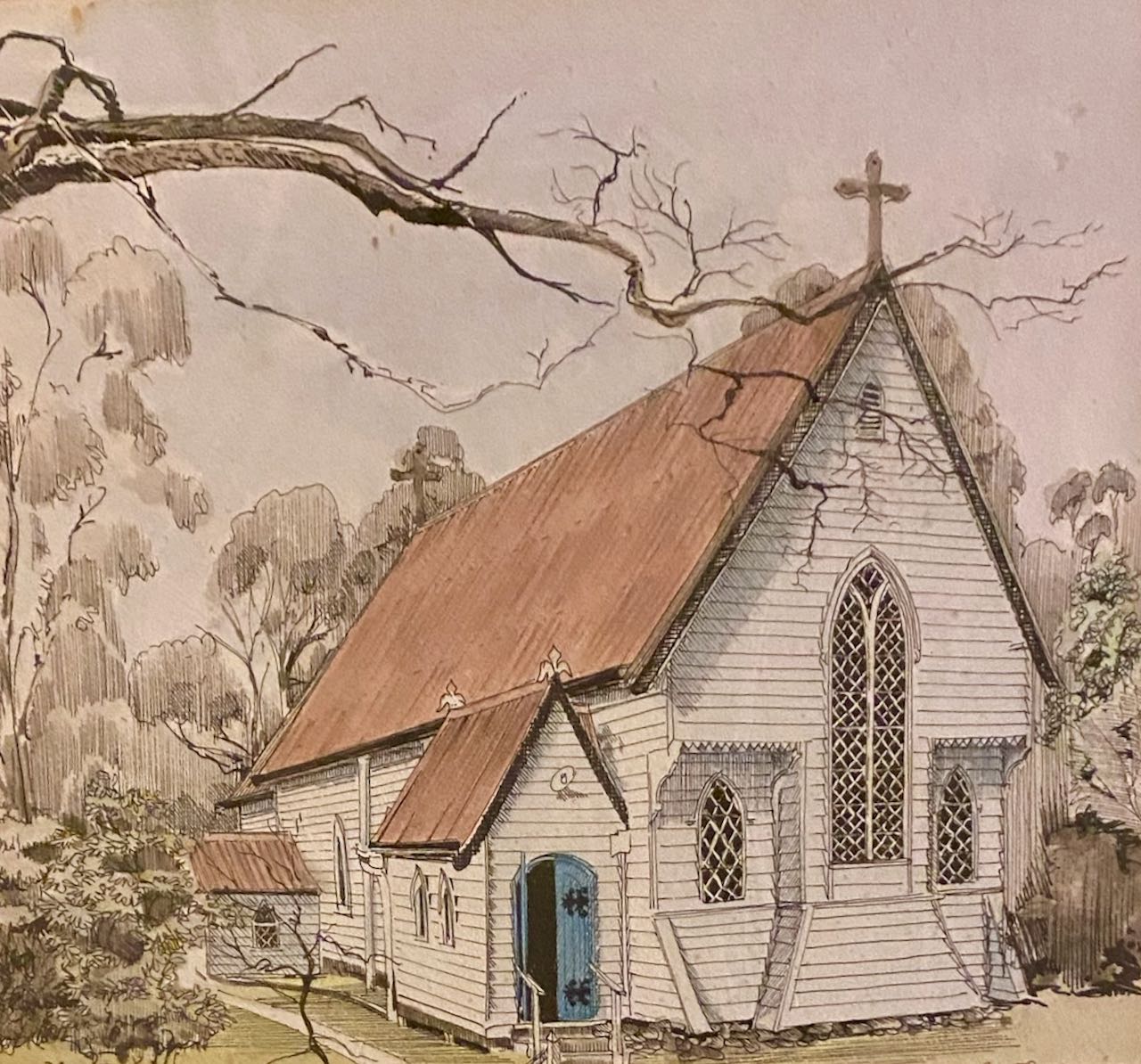
Indeed one of those donors with their names on the back of the picture was a ‘Robert’ who may have been Robert Coy himself; he would have been about thirty at the time, roughly the age of the others who lived in the house. Leslie greatly appreciated their artistic, musical and literary interests.
Leslie Bull’s time at Lorne represented a very creative period in a way that had not characterised his previous life. Prior to his arrival at Lorne a new vicarage had been built behind the church in place of an older one that had been demolished. On his arrival the grounds between the vicarage and the church still bore the character of a building site, ravaged ground and no vegetation. Leslie set to work to create terraces in the area immediately below the new vicarage, built them up with soil and suitable compost matter (including seaweed dragged up from the beach), and planted them out with a mixture of native shrubs and vegetables. By the time he left Lorne the space between the vicarage and the church had been beautifully transformed.
In 1980, at the age of 80, Leslie was retired from Lorne because of a policy by Archbishop Robert Dann that priests in their eighties should no longer be in charge of parishes, much to his regret as both he and his parishioners considered that he still had much to offer in the role and that health-wise he was still very fit. Ironically the much younger priest appointed in his place only lasted a few weeks before he had a heart attack and died and Leslie was recalled to take services at Lorne until a replacement was found. His wish to remain living in Lorne was frustrated by rapidly rising house prices and he moved to Geelong, where for some years he acted as a non-stipendiary assistant priest and as a member of the choir at All Saints Newtown. He died in July 1998 at the age of 99 and his ashes are buried in the memorial garden he established on the ocean-side of the church at Lorne.
Sources
- Philip Bull, 1 June 2025

