
Lorne Victoria Australia
6 February 2026
The Marion
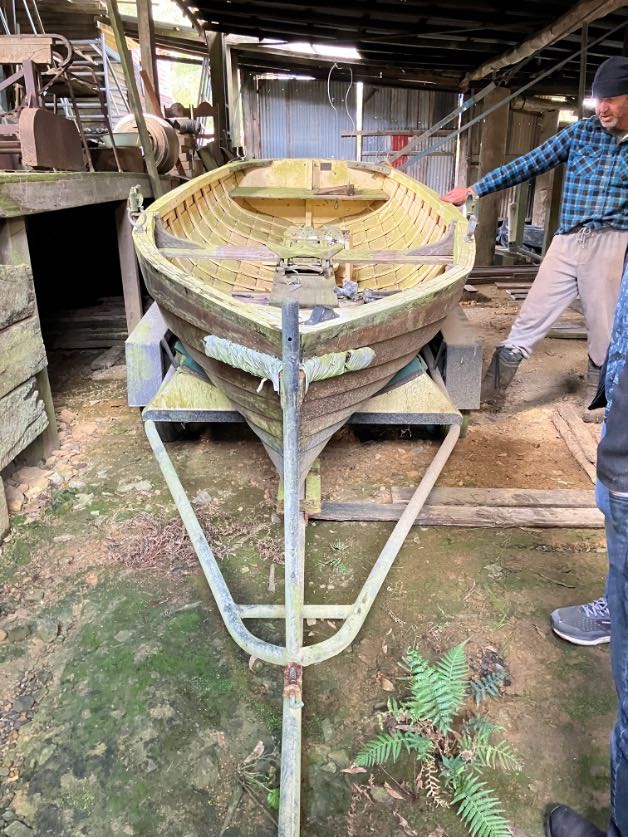
A piece of Lorne’s surf and fishing history has arrived at the Men’s Shed, via some exceptional organisation from the Men’s Shed founding father and stalwart, Allan Walls. Over the next year or so, a superbly built little craft, the Marion, will slowly emerge from its near-forgotten and lonely obscurity on the lower level of Babington’s old sawmill at Wymbooliel on the Benwerrin-Mt Sabine Road. Just like the ugly duckling became a beautiful swan, it will regain its grace through the largest renovation program the Shedders have yet undertaken.
‘Ado’ and ‘Marion’
In late 2021, the Lorne Historical Society arranged a mill site visit with its current owner, Adrian Elliott, to learn more about the 19th- and 20th-century Otway timber industry. Always a sucker for boats, I couldn’t help but notice a dusty maritime relic tucked away on a lower level of the mill. I remember thinking “… that’s interesting … I wonder what it is?” … then promptly forgot about it.
A year or two later, when the Co-op discussions were in full swing, and the LHS suggested that a couta boat might serve as a fitting focus for a historical display, I recalled the old boat at the mill.
Thinking it might be an option and knowing that Allan—the human equivalent of a British bulldog who pursues his ideas with grim determination [ref: the Shedders bin lid project, or the Shed itself]—was seeking a renovation project for the Shedders to sink their teeth into, I suggested the old boat might be worth a look. That was all it took. Allan was off and running.
After a site meeting with ‘Ado’, and once the provenance of the old girl had been established, Stewart and Tony Stribling … the family had been original owners of the Marion [as we now knew her to be] … were contacted. Their individual insights follow—each a golden memory of Lorne’s simpler times. I hope they will forgive my light editing of their responses.
Stewart Stribling wrote the following:
“I went with my father, Hector, to a boat exhibition where he purchased the Marion. I think he paid about £50 for it. Hector already had two other wooden boats in Lorne.
I remember when a huge shoal of salmon or mullet were running, and Hector took out the Marion from the main beach. He strung a large net at the back of the Marion—probably 100 yards long—and he caught about 40 boxes of fish, which he then gave to the Lorne locals. I remember Roy Harris being with him in Marion on this occasion.
Hector loaned the Marion to the Lorne Surf Club for a couple of seasons, when Don Stewart was in charge of the Surf Club.
I remember when the Surf Club held a mini surf carnival at Lorne Beach. Don took up the microphone and told the spectators to watch the Marion shoot the waves. This occurred before Frank Beaurepaire donated the first surfboat to the Lorne club. I remember Don explaining to the crowd that the club could not afford a surf boat and the Marion was the best they could do.
When Don took the Marion out, he was the sweep oarsman while there were two rowers—Roy Harris was one, but I cannot recall the other. Don handled her well in the surf, and she was a very stable boat.
Hector also loaned the Marion to several of Lorne’s fishermen, as they liked shoaling nets from her.
I am not sure why my father bought the Marion—perhaps he just liked boats and fishing.”
Tony Stribling’s “Marion Memories” add further provenance:
The “Marion” was British Seagull Outboard’s demonstration boat at the 1948 Melbourne Exhibition Buildings Boat Show when it slid down the stairs, damaging the rear of the keel. Henry Love and his friends used it as the Surf Club’s first surf boat—though obviously [only] in small waves—with a 3-person crew. [Author’s note: Don Stewart’s use would likely have preceded Henry’s].
In my time [1960 onwards], it had a 5hp Seagull motor. This could be tricky to manage, but I soon learnt that when going over a steep wave and the bow lifted, the exposed spark plug at the stern would dip underwater, cutting the motor. I had to be ready to call to my two oarsmen to quickly extend the oars so we could get out past the front beach break. At this time, it lived in my father’s pier-side boatshed along with his larger inboard clinker.
When Paddy Love retired [Paddy was Bill’s brother and Henry’s uncle], I would give him the boatshed key and the use of the Marion for his trips to the back of Point Grey. He loved being back out to sea and looked after the dinghy as if it were his own. After periods of low use, the hull would need to be filled with water for several days to swell its planking and make it water-tight.
I remember that Barry Morton and I would cover the floorboards with large flathead at the George mouth in quick time, though we would have thrown back today’s size fish. This must have been about 1964, before Barry tragically killed himself when speeding on the Deans Marsh Road.
The Marion then sat unused on a trailer in the back shed at “Yuruga” [Author’s note: Yuruga was the Stribling home next door to the Pacific Hotel, now just a fallow building site], as its 5-knot speed became an embarrassment in the speedboat era. When my brothers sold “Yuruga” and its sheds in 2001, I was left with the task of clearing out any assets and removing the rest. Adrian [Ado] Elliott—who was involved with the Myer family at Benwerrin—bought the Marion, intending to recondition her for use on a dam at the Myers’ short-lived Benwerrin retreat. As that never eventuated, she was stored at Ado’s old sawmill site.
As she is a classic-style dinghy with a significant history at the surf club, it would be great to prevent her from rotting away in a shed.
When GORCAPA showed no interest or foresight in incorporating the renovated Marion in the ‘new’ Co-op building—the first proposal—Allan turned to Heath Armstrong, the current President of the Lorne Surf Lifesaving Club. Heath had no hesitation and promised the support of the club, pledging to fund the Men’s Shed restoration project and proudly showcasing the finished Marion at the club as Lorne’s first surf boat.
The Shedders, the town, and the Stribling family are all profoundly grateful to Heath and the LSLC committee for their willing support and for providing a permanent future home for this exquisite craft.
John Agar
Feature Writer
A word from the Chair
Hello
Well, quite a start to the year it has been thus far! As well as our normal challenges of dealing with a huge influx of visitors (whom we love!), we have had to deal with bushfire threat, then flooding (minor in Lorne) and then bushfire threat again. Thankfully no locusts or toads just yet! But now we face an equally destructive threat to our businesses and our local economy, the misreporting and over catastrophising by mainstream media of the weather events which have recently impacted Surf Coast communities.
I am in no way downplaying the severity of the bushfires and the floods, the destruction and pain felt by our inland and coastal communities, nor the personal loss and suffering of many. What I am criticising is the misreporting of the situation by mainstream media. When incidents in the Otways are reported, invariably the towns of Lorne and Apollo Bay are rolled in even though there has been no direct (or indirect) impact to our communities.
While the vision of a helicopter hauling battered cars and caravans out of the surf makes for good television, it also sends a signal to viewers that the whole Surf Coast is a disaster zone and to stay away. When cub reporters, keen to make their mark, talk about the devastation in the region, do they or their bosses think about the impact their catastrophic reporting is having on our local businesses.
For example, in Lorne the only ongoing impact of the bushfires and floods this summer is that one of our four caravan parks is closed. Yet our local businesses are seeing substantial drops in patronage and revenue (in some cases more than 50%). Many of these businesses rely on this time of year to fund them through the quiet times of the year ahead.
I urge all media outlets to get their information from credible local sources. I also urge the government to consider a voucher scheme to encourage visitors to visit and spend on the Surf Coast. A modest amount of $10 million could provide 1,000 x $100 vouchers to be spent on the Surf Coast. That would be a good start and would hardly dent our Federal and State budgets.
And let’s get the message out there “LORNE AND APOLLO BAY AND THE OTHER COASTAL COMMUNITIES ARE OPEN FOR BUSINESS. WE WANT YOU AND NEED YOU TO VISIT. LOVE LORNE”!
*****
Our cricketers had a resounding 161 run win against City United last Saturday at Stribling Reserve with stellar bowling performances from our young guns Zavier Hollmer (5/18) and Jack Heathcote (2/10). Having secured their place in the finals with three games to go, the Dolphins are looking forward to a top of the table clash with Apollo Bay on Saturday February 14 for the Coastal Cup and annual Pink Stumps Day. This special event is to raise funds for the McGrath Foundation. It will be a great day for a great cause. Tickets can be purchased through – https://tinyurl.com/pink-stumps.
Cheers
John
John Higgins
Chairman, Committee for Lorne
13 February 2026
The Remarkable Barnacle

In all innocence and ignorance, I thought to write an ‘ain’t-nature-grand’ piece about barnacles. Why? … well, after the latest easterly, I chanced upon a not-uncommon ‘find’ on our beaches, a goose barnacle-encrusted length of driftwood.
My article was to begin as follows … but <Spoiler Alert> the story will take a quite remarkable and unexpected twist! It began ….
The goose barnacle [Lepas anatifera] is a crustacean that flutters about like a palm in a strong wind, its base anchored to its preferred attachment—whether that be a barnacle-covered hull, a piece of driftwood floating with the tide, or a more permanent address on a rocky tidal shelf.
Surprisingly, barnacles are not related to bivalve molluscs—think mussels, oysters, pippies, and those beautiful little sand wanderers that leave wiggly grooves in the wet sand at low tide … the ones that mysteriously start from nowhere [Point A] and just as inexplicably end at nowhere [Point B].
No, they are actually a close relative of crabs and lobsters, although quite tethered. Even after studying them closely, it’s still hard to fully grasp their kinship, but they are indeed kith and kin…again <Spoiler Alert> there is more on this to come!
With a lifespan of up to 20 years, barnacle colonies have been the bane of sea-going vessels ever since humans took to the sea in ships. They are the main reason ships and boats are careened [olden days], scraped [nowadays], and coated with anti-fouling paint.
Known for their long, fleshy, flexible, and vaguely sinister-looking stalks and their bivalve-like calcareous armour, they do rather mimic the neck, head, and white chubby cheeks of a goose—hence the name.
These creatures attach to floating objects, like driftwood or ship hulls in the open ocean, and form colonies where they filter plankton for food through their feathery appendages.

Large clusters are often found on driftwood washed ashore by storms, where they can survive out of seawater for quite a long time. And, although I struggle with the thought of eating one—perhaps a touch hypocritically, given that I am an oyster and mussel devotee—they are a sought-after marine delicacy in some cultures.
There is a wide disparity in the number of described species … Wikipedia claims 2,100 [https://tinyurl.com/5dk4ympa] while Saltish Magazine suggests only 1,200 [https://tinyurl.com/salt-barnacle]. Often, the differences are minor, with some sources engaging in the unavoidable classification debate: are these genuinely new species or just intra-specie adaptations?
Whatever the case—whether the tough North Lorne acorn barnacles that hurt my barefoot soles when chasing Blighty barefoot across the rock shelves, the vaguely gruesome ones that wave like mini-triffids from a driftwood log, or even the political flotsam that governments try to ‘scrape away’ before the end of a parliamentary term—barnacles are a fact of life.

Common acorn [or rock] barnacles
In “Darwin and the Barnacle” [https://tinyurl.com/bdcu89b8], author Rebecca Stott shares a fascinating and true story of how “… one small curiosity from the natural world contributed to history’s most spectacular scientific breakthrough.” Summarising a synopsis of Stott’s work, it goes something like this:
… Pairing Charles Darwin and the barnacle as her two unlikely protagonists, Rebecca Stott has written an absorbing scientific detective story that sheds light on Darwin’s greatest achievement—the theory of evolution. Starting her scientific detective story in the 1820s—even before Darwin’s voyage aboard the Beagle began—Stott investigates why he delayed more than twenty years between developing his key theory of natural selection and publishing it. Richly illustrated and filled with riddles and ideas that challenged Victorian-era scientific understanding, “Darwin and the Barnacle” is a captivating account of how his wonder at this tiny creature led to one of history’s most remarkable scientific breakthroughs.
If asked to identify the animals that most influenced Charles Darwin, we would probably choose the Galápagos finches, but the truth is, Darwin didn’t actually care much for finches. Indeed, he didn’t specifically mention Galápagos finches in “On the Origin of Species” https://tinyurl.com/47ct3fkh]. But if not finches, which animals had the greatest impact on his theory of evolution? Pigeons played a role, as did worms, but the most significant influence on Darwin was the much-despised marine pest—the barnacle. For anyone looking for an engaging layman’s explanation of Darwin’s pursuit of evolutionary truth … it reads like a Hercule Poirot-esque detective series … I can wholeheartedly recommend you spend ten minutes reading Sam Kean’s article “Darwin’s Barnacles” in the Science History Institute’s Distillation Magazine. It is a story not to be missed [https://tinyurl.com/mth35pje].
I have paraphrased Kean’s conclusion like this: “… we expect eureka moments or sudden flashes of insight [think Archimedes and his bathtub]. We all love a bit of drama. But Darwin’s patient years of labour hunched over his smelly barnacles were actually quite the opposite. It took him ages to notice that, in successive generations, certain organs in one barnacle species would often be repurposed in another, and that unused organs would gradually wither away. In fact, his meticulous work and obsession with barnacles were vital as he refined his once-vague theory of evolution into the coherent whole he finally published as “Origins” … a monumental work that would change science forever.
So … the next time you see a barnacle-encrusted log washed ashore by a furious sea or curse the sharp imprint of an acorn barnacle as you chase your dog across the rocks, pause for a moment and think of how those tiny creatures delivered Charles Darwin his theory of evolution.
Our world does, indeed, move in mysterious ways!
John Agar
Feature Writer
A Word from the Chair
Hello
Well ,it’s finally happening, the Point Grey redevelopment has started! The plans are finalised, the builders are on site and the safety fences are up. We now hope for kind weather and energetic and organised workers to bring the vision to life. For too long this iconic part of Lorne’s history and social fabric has been decaying and we will watch with excitement as the new Point Grey unfolds. The appointed builders, Bowden Corporation, are well known in Lorne having completed the Stribling Reserve Community Pavilion some years ago and they have a reputation for completing projects on time including more recently the Whittlesea Aquatic Centre and several school and hospital projects. The schedule is to have the precinct completed, open and functioning for next summer season. We can’t wait!
*****
As we tick Point Grey off our to do list, we turn our minds to a less savoury topic, toilets, and specifically at the Memorial Arch and Teddy’s Lookout. Every day, hundreds of tourist buses and cars stop at the Memorial Arch for the must-have photo or selfie, disgorging thousands of people into this confined space. It’s a perfect place for a toilet break, but where are the toilets? They don’t exist! So, what happens when nature calls, nature does! The result is a stinking filthy mess in what should be one of the most iconic and respected locations on our beautiful Surf Coast. Is this the best we can do for the world’s biggest war memorial (yes, the Great Ocean Road is that!), the memory of the diggers who fought for our freedom and the ex-servicemen who created the Road. I am not sure whose responsibility it is (Surf Coast Shire, GORCAPA, VicRoads?) but let’s get it fixed.
While we are at it, what about doing something for Teddy’s Lookout. Once again, this scenic lookout is on every tourist’s must-do list but no toilets to be seen. The result, another picturesque spot turned into an open-air toilet. We can do better than this!
So how do we fund these projects. Take a look at your rate notices and your land tax bills and see the extraordinary increase in taxes and levies that our State Government is sucking out of Lorne. It’s time to get some of those funds spent in our community!
*****
Our cricketers have continued their winning way with an emphatic victory over Simpson last Saturday. This week they take on our neighbours, Apollo Bay, in the Coastal Cup and for a top of the ladder position. It is also Pink Stumps Day, so wear something pink and join us at Stribling Reserve starting at 1.30pm.
*****
It is great to see the Lorne Theatre open and screening films again on a regular basis. If we want to keep this wonderful facility alive, we need to support it, so treat yourself and someone special to a night out.
And to all you lovers, old and young, Happy St Valentines Day!
Cheers
John
John Higgins
Chairman, Committee for Lorne
20 February 2026
Archie Colquhoun

When old photos of Lorne pop up on the Lorne Facebook Page, they are usually greeted with a cloud of jogged memories and “I remember when’s” from those with Lorne blood coursing in their veins. The same, however, could be said of the watercolour and oil works of our multiple coastal artists—Susan Sutton comes immediately to mind, though these are rarely, if ever, shown—except in art exhibitions. Further, any artwork that is seen is primarily contemporary, but what of artists from Lorne’s earlier days—before the advent of the beach cabana?
Suddenly, I remembered Archie!
When I was very young in the decade immediately following the end of WWII, I vividly remember watching ‘Archie’ as he sat at his easel amid the then-exuberant marram grass that flourished on a much larger and longer Erskine Point, painting the expansive coast that stretched past Eastern View [no houses] to the Airey’s lighthouse.
Although I must have been no older than five or six, I remember watching for him from my Gran’s balcony, and as soon as I saw him setting up his easel and canvas stool, I would badger Mum or Gran to take me across the swing bridge to sit in the sand by his side and marvel at how he could translate the ‘actual’ view onto his canvas and make it spring to life. I also remember scoring a cuppa from the thermos of tea at his side, and that he would kindly invite me to share his Edinburgh shortbreads from a cake tin with a Swiss alpine scene on the lid.
Although I never tired of watching Archie paint from his favourite sheltered spot amid the tussocks near the Swing Bridge, I don’t think my artistic skills could have impressed him much, because although he would occasionally give me a brush, a sketch-It pad, and encourage me to ‘have a go’, it must have been very obvious to him that this was no artistic genius at his side.
While researching ‘Archie’… correctly, Archibald Douglas Colquhoun [phonetically pronounced Ca’hoon] … and his equally talented painter wife, Amalie [Millie], I discovered that he had studied under Frederick McCubbin and been mentored by Max Meldrum, the founder of an Australian art movement called “tonal realism” and one of Australia’s most prominent artists during the inter-war years of the 1920s and 1930s.
The Meldrumites, as they were called: “… favoured painting in adverse weather conditions and would often set out in a group in the early morning or towards evening in search of fog and wintry wet surfaces, as these, Max insisted, produced stronger spatial effects.” [see: https://tinyurl.com/eev7csms]. Max was a close friend of my father’s parents and was a frequent guest at “The Ruff”, their ramshackle self-build at Chum Creek near Healesville, where he painted many of his notable ‘tonal’ landscapes, though he was better known for his portraits and won the Archibald Prize twice in 1939 and 1940. Our family has been fortunate to share quite a collection of ‘Meldrums’, with several once gracing my parents’ walls.
When I recently discovered ‘my’ Archie’s connection with Meldrum, I couldn’t help but notice the similarity in artistic style between Archie’s misty views of Big Hill and Eastern View and my memory of Meldrum’s Healesville landscapes hanging on our walls!
For those interested in seeing more of the Colquhouns’ work—pieces displayed in the National Gallery of Australia, the State galleries of New South Wales, Queensland, Victoria, and Western Australia, as well as many regional galleries—visit https://tinyurl.com/mrdx8b6x. To whet your appetite to explore, here are a few examples of Archie’s works. I’m sure you will enjoy the ‘uncluttered’ views!


These few examples of his work speak to a gentler, less angry, less strident Australia, an Australia that our parents and grandparents fought and died to leave for us, yet an Australia so many today seem hell-bent to destroy.
John Agar
Feature Writer
A Word from the Chair
Hello
Stribling Reserve was a sea of pink last Saturday as Lorne’s finest came out to watch cricket, celebrate, listen to our inspiring Cam Nugent, and raise funds for the McGrath Foundation for cancer research on the annual Pink Stumps Day. It was a most enjoyable day with some thoughtfully selected outfits and lots of laughter and chatter. Nearly $6,800 was raised for the McGrath Foundation. Well done to the organisers and generous attendees.
It was also the annual Country Cup match between Lorne and Apollo Bay with a top of the ladder spot at stake. Unfortunately, it did not go to the fairytale script for Lorne with the Bay winning in convincing style. In the spirit of the day, the winner of the Man of the Match award, Jack Pascoe, Apollo Bay gun batsman, generously donated his $300 prize money to the McGrath Foundation. Well done Jack!
With one game to go before finals, Lorne sits comfortably in third spot but will need to play some quality cricket to be there for the “last dance” and avenge last year’s one run, last ball loss. Sorry to bring that up boys!
******
Last Friday the Aquatic Club took over its temporary home at the Surf Club after a couple of false starts. About 180 members and guests turned up, somewhat overwhelming the bar staff! They were assured that this was a combination of perfect weather, curiosity to check out the venue, and an opportunity to catch up with friends after a three-week hiatus, and they should not be gearing up for this number every week. We will leave it a little longer before we change the sign on the building (Ha Ha).
Meanwhile at Point Grey, work is well underway on the removal of asbestos and demolition, silencing the naysayers who predicted that the site would be fenced and left in abeyance for months. We have been assured by the builders and architects that the demolition of the Co-op building will be carefully done to salvage materials that can be re-used in the recreated building. All looking good so far!
*****
As Lorne gets back to some normality after a summer punctuated by bushfire risk, flooding and visitor reluctance, it is a time to stress the importance of supporting our local businesses. Can you imagine Lorne without a bookshop, a pharmacy or range of clothing outlets? It’s unthinkable, but as long as people go to the metropolis to shop, or shop on-line, the economic impact is felt by our local traders. This of course does not apply to wine, because if people stopped buying wine on-line the Post Office would have nothing to do!
And what about our supermarket? It must be the best-stocked supermarket anywhere, with friendly and helpful staff, no self-service checkouts (thankfully) and a proud and generous supporter of our community. Why would you not support them rather than buying from one of the big multinationals who have to truck goods into town. Let’s get rid of the “you-know-who trucks” from our town. You may be saving a few dollars, but in the long run we and our community lose. Go local!
Cheers
John
John Higgins
Chairman, Committee for Lorne
27 February 2026
The George

I remember a phrase my mother used, now and then, to explain—or not—the vicissitudes of the natural world.
“Nature is as nature does”, she would say with a wise nod, as if all the wisdom of the world was cradled within.
I never gave it a whole lot of thought at the time—it seemed a trifle deep for a young boy besotted with tossing and catching his football—and I confess to putting it aside.
At the George, today, five weeks ‘post-deluge’, that phrase suddenly came back to me … with a vengeance. I suddenly had a deep sense of her meaning.
Back when the world was Google-less, the closest I had to an independent resource was a complete set of Encyclopaedia Britannica, but it performed poorly with phraseology. Words, yes: phrases, no.
Could it be Shakespearean, I wondered. However, although Shakespeare invented over 1,700 new English language words and sayings that are still in common use, including such phrasing gems as “one fell swoop,” “in a pickle,” “good riddance,” “heart of gold,” and “wild-goose chase”, “nature is as nature does” does not appear to be one of his. So, I googled, and while it wasn’t very helpful regarding a likely ‘origin’, Google did have a bit to say about the phrase itself.
As any Google search now seems to begin with an AI summary—a trend I find annoying, as I prefer, enjoy, and learn far more from performing my own sift of the sources [herewith a spoiler alert for our young], something made me read this one. Quite surprised, I rather liked it! It read as follows:
“The phrase—nature is as nature does—emphasises that the essence of any entity, whether a living organism, ecological system, or human, is defined by its actions, behaviour, and inherent character rather than just its appearance. It signifies that nature acts according to its own laws, encompassing chaos, growth, and survival”.
Gee, I thought, that’s a bit turgid, but getting the gist, I read on …
- A thing’s “nature” is understood through how it acts, reacts, and unfolds.
- The phrase implies that nature is not static but is a dynamic, living process and suggests that everything, from a storm to a human, operates according to its fundamental, inherent nature.
Here, the AI summary started to stray off pisté, so I will spare you the rest, but I reckon you’ll be getting the gist, too.
Driving around the coast to the Kennett and back, the marks left from the beating that nature recently handed out to itself still lay heavily on the eight river beds and estuaries that had borne the brunt of January’s flood. Although the smashed cars and vans had long gone, the physical changes to the estuaries remained and will inevitably take a far longer time to heal.
However, one river bed stands out as the most severely devastated, the most architecturally altered … the St. George [locally simply known as ‘the George’]. Although the damage to infrastructure, possessions, and equipment—the dollar value and the heartache of loss—is more evident along the banks of the Cumberland and the Wye, the gouging change to the river bed and banks of the George seems at another level—at least as far as can be seen from the GOR—though as access to many of the walking tracks has been temporarily blocked by GORCAPA to permit ‘repairs’, it is possible that equal or worse scouring may be present further up the other rivers but currently out of view.

Perhaps the damage appears all the more shocking and impactful because the George is so close to Lorne, is a favourite spot for walking our dogs off-leash, and is a cherished and safe summer refuge for young families seeking to escape the cabana-covered mayhem of the main beach.
Suddenly, gone is the shallow stream that, for generations, has meandered through an expansive golden sandbar and provided local parents with a safe place to teach their children water safety, though the narrow seaward inlet is not a surf-safe spot and has a tricky rip on an outgoing tide that demands care and respect. Now, storm-washed tree trunks and debris lie everywhere, while its broad, tempting sandbanks have been washed clear away. Little remains but rubble, rocks, and a jumble of driftwood.
No doubt it will heal in time—indeed, there are signs that it already may be—but it is still hard to imagine how, or what form that repair may take. Hopefully, the always higher winter tides and stronger winter water flows in the river will combine to slowly float and wash the smaller branches, logs and debris out to sea. But, as I stood on the George’s damaged banks a week or so after the flood and watched the heavy lifting equipment that had been brought in to clear the Wye and Cumberland of their debris roll on past on the way back to Geelong, I couldn’t help wondering why they weren’t stopping here, too. One day’s work would have done it. Just one day … but then, just like the trucks, the moment passed.
Unlike the rest, the George appears to have been left to fend for itself.
Nature will eventually reshape this once-idyllic spot—of that we can be certain. But without some help to clear the heavy debris, it will take a long time. I can only regret an opportunity lost as those trucks rolled on by. Meanwhile, Lorne has lost one of its natural gems.
With Point Grey, Vera Lynn, and Rosie’s seat off-limits, access to the pier complex is restricted, and with many local walking tracks and bush picnic spots also closed, the coincidental loss of the George will be deeply felt by our small community. Had Lorne still been locally managed—as it once was—things may have been different, but now ‘managed’ from afar by ‘managers’ who lack local nuance or knowledge, such sensitivities have been lost
As Lorne has taken quite a few gut punches lately, it’s hard not to wonder what may come our way next.
John Agar
Feature Writer
A word from the Chair
Hello
Someone once said, “If you remember the 70s you weren’t there!”. While this may resonate with many who were “there” in the 70s, many of those same people are now facing the real 70s and the challenges and opportunities that brings. We are fortunate that with advances in medicine and technology, most of us can expect to live longer than our parents. However, we cannot and must not take that for granted as many new and unexpected medical conditions can change our life plans very quickly. We all know of friends who have quickly declined from fit and active people to be confronted with life-threatening and life-ending conditions. While this may seem a morbid topic for this column, my point is to stress the importance of making the most of every day, doing what you want to do rather than what you feel obligated to do: to travel, to socialise, to read, to sing, to swim or just to be still. Make these 70s memorable!
We are especially fortunate that being in your seventies in Lorne (one of the world’s “Blue” zones, but don’t tell everyone!) is not a ticket to the retirement home or the “lifestyle community” as some are quaintly called. No, the septuagenarians of Lorne are bike riders, Mermaids, golfers and bowlers, as well as the backbone of many of our community organisations including the Op Shop, the Aquatic Club and the Men’s Shed.
*****
As we say farewell to summer (officially) for another year, we look back on a season which was different in many ways. It was not a great summer weatherwise, with some extremely hot days and some unseasonally cold days (some people had an open fire on Christmas Day!). We lived with the threat of bushfires which fortunately did not eventuate to impact Lorne, although many of our neighbouring towns suffered greatly, and we lived through the riverine flood which caused relatively minor damage in Lorne but devastated nearby communities. Unfortunately, the media reporting of these events deterred visitors from coming to Lorne and severely impacted our local businesses for several weeks, however more positive and accurate publicity has seen the return of visitors in numbers and smiles back on our traders’ faces.
The Point Grey redevelopment continues apace with site preparation well underway. There have been some unfortunate and inconsiderate hygiene and parking issues which have impacted local traders, residents and beach users. GORCAPA has responded promptly when these issues were brought to their attention, with the installation of temporary toilets and an undertaking to continue to monitor the situation and to continue to liaise with affected parties.
*****
Our cricketers had a comfortable five wicket win last Saturday against Colac in their last home and away game. They have finished the season in third place and now face a must-win final against Tomahawk Creek to stay in the running. The game will be at Birregurra starting at noon this Saturday and our players look forward to your support. Good luck boys!
Cheers
John
John Higgins
Chairman, Committee for Lorne