
Lorne Victoria Australia
In the late 1840s William Lindsay, Master of the cutter William was searching for coal along the Otway coastline. We are not certain of the results of his endeavours, however he did discover important locations with valuable timber between Apollo Bay and Louttit Bay.
In 1849 he was granted what was known then as a splitters licence to cut timber. He was put ashore from the schooner Margaret with his wife, Mary Ann Lindsay and children plus food and tools of his trade. The Margaret was purchased specifically for the transportation of the timber to satisfy a growing demand in the newly established colony of Port Phillip, today’s Melbourne. Apart from normal timber-split palings, wattle bark and short roof shingles were also loaded for the thirty hour sailing journey back to Corio Bay at present day Geelong.
Unfortunately on 28 January 1850 tragedy struck. The Lindsays’ two small sons, William (8) and Joseph (4), had burrowed a tunnel into a sand cutting while playing near the mouth of the river. The tunnel collapsed and smothered them. Their grave can still be seen on the high ground near the Swing Bridge, suggesting quicksand was the cause of the children’s deaths, but it’s now thought it was the collapse of the sand bank.
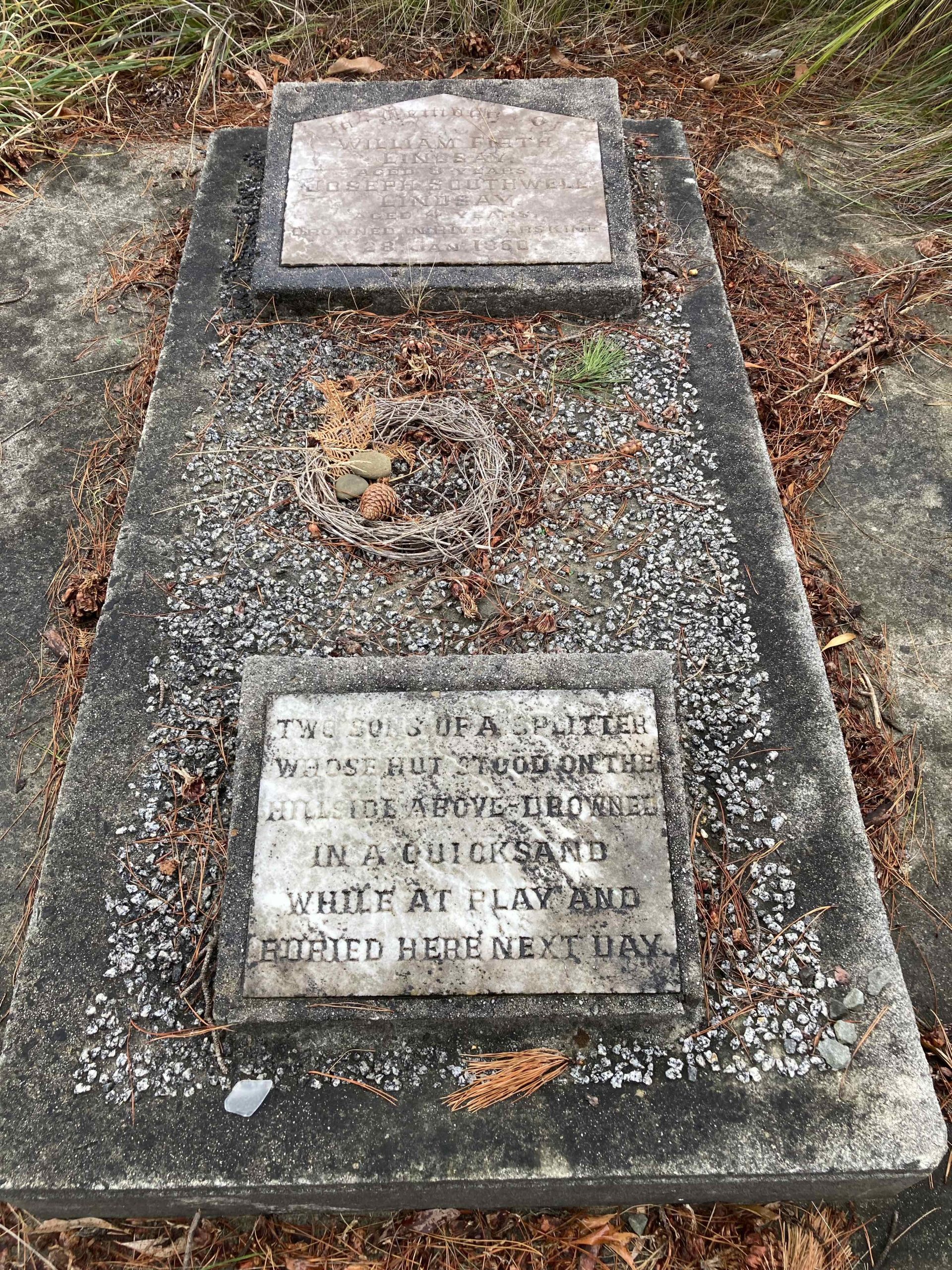
Grave of Lindsay children
Unable to remain at the site of such a painful tragedy the Lindsays moved to Canada where they were blessed with a family of girls.
George Clissold recalled that in 1914 while in the Erskine River, he was approached by two women (mother & daughter) who had just visited the grave of the children who were smothered in the Erskine River. The mother was very old in years (about 90, presumably Mary Ann Lindsay). They had arrived in Lorne the day before but could not get accommodation. Mrs Herbert of “Carinya” helped by making a bed on a couch for them that night and they left next day as no further accommodation was available.
The daughter said that her father operated a small ship with which he carted split posts to Melbourne, towing the posts out to the ship behind a row boat. The mother and daughter lived in a bark hut among the tea-tree near the beach. One day after the river had cut through the sand bank, leaving steep banks along the edge of the river, the children were playing on the banks. The owner of the boat passed them and crossed the river to see their father whom he employed to split the posts in the area of the present cemetery. When he returned to cross the river again the children were lying in a hole in the river, the bank of sand had fallen on them.
On the day of the disastrous bush fires all over Victoria (known as Black Thursday, 6 February 1851), they all cleared off to Melbourne in the boat, when they returned to Lorne everything was burnt so they did not stay anymore. That day in 1914 was their first return and as far as George Clissold knew, their only return to Lorne to visit the grave of the lost children William (8) and Joseph (4), sons of William and Mary Ann Lindsay.
Sources:
- Lorne A Living History by Doug Stirling
- Anecdote from George Clissold written by his brother Cecil (“Tiger”) Clissold.