
Lorne Victoria Australia
3rd April, 2026
Superstar Re-visited
There is a line near the finale of the timeless 1970 rock opera, Jesus Christ Superstar [Music: Andrew Lloyd Webber; Lyrics: Tim Rice], where Judas Iscariot is anguishing over whether Jesus’ spiritual message is being overshadowed by “shallow, modern-style celebrity hype”. In the penultimate song, ‘Superstar’, the troubled Judas pleads with Jesus to explain:
“Every time I look at you, I don’t understand,
Why you let the things you do get so out of hand?”
With Easter upon us, and as more busloads of tourists pass by along the Great Ocean Road, ferrying people from who knows where to see who knows what, my thoughts turn to sacrifices, crucifixions, and GORCAPA … the rapacious coastal ‘overlord’ that is so mindlessly sacrificing the enduring natural wonders of the Otways—its spiritual beaches, hidden coves, ancient forests, sea-carved limestone cliffs, and unique fauna—on the fleeting altar of tourism.
Consider for a moment that day-long bus tour to and from Melbourne … and, believe me, in anyone’s estimation it is a long day! The attraction itinerary will look something like this:
Attraction #1: a toilet stop by the Anglesea River, where the bus will pause long enough for a wee, but not enough to ‘see’ anything.
Attraction #2: the Archway at Eastern View for a quick 3-minute selfie on the beach, and two more: one in a risky spot on the road in front of the Arch and the other beside its Digger’s sculpture. Oh, yes, and more wees [NB: no toilet, just bushes] for those who missed out in Anglesea.
Attraction #3: Lorne? … but no … with no easy place for buses to stop, Lorne is often skipped.
Attraction #4: Kennett River to see koalas that, with the wisdom of Job, have retreated deep into the bush to escape tree-rocking, stone-throwing passers-by who seek ‘to make them move’.
Attraction #5: Apollo Bay for a Chinese takeaway, chips, coffee, and a street stroll, though there is little extra time for a proper ‘shop’.
Attraction #6: the Otway Rainforest, most commonly viewed from the bus window as it passes through at 60km/hr.
Attraction #7: The Twelve Apostles [ignore the minor misnomer as only seven remain] for the ‘destination stop’ at the new, over-designed $120 million Visitor Centre. Here, following the tour guide’s flags, lucky visitors may ‘experience’:
- A breath of Southern Ocean air at Loch Ard Gorge … though access to the cove and cave has been closed by GORCAPA ‘for our safety’.
- Gibson’s Steps … also intermittently closed due to rockfalls and geological movement.
- London Bridge … though it collapsed in 1990 and is no longer a bridge but a separated limestone stack.
- The Grotto—a recently popularised name for a natural formation featuring a once-mesmerising blowhole [recently desecrated by a manmade structure made from steel, aluminium and concrete—some architect’s bad dream], a rock archway, and a cave … though tides and time often mean tour operators ‘give it a miss’.
Attraction #8: Another ‘loo’ stop, some dim sims, and a takeaway coffee in Port Campbell before …
Attraction #10: an inland journey with a no-stops dash through the rolling Western District countryside past Colac** and back along the highway to the ‘safety’ of Melbourne.
** Author’s Aside: Buses now avoid stopping in Colac, a regional city with a population of ~13,500 [perhaps with tourist safety front of mind], given that its police station, after first ‘transitioning’ [bureaucracy loves that word] from 24-hour service to ‘business hours only, was then completely closed to public access in March 2026 citing a mix of staffing shortages, damage to its doors, limited management resources, and a lack of funds.
With a driving time from Melbourne to Port Campbell [6+ hours] and back via Colac [another 3+ hours], it’s no surprise that most rush past Bells Beach, few mention the Cape, and the Bay of Islands isn’t on the list. So far, they’ve all dodged a bullet, and long may it stay that way!
Picture the conversation when, feeling a little betrayed and numb in the buttocks when back in the big smoke, the weary travellers borrow another line from ‘Superstar’ and ask each other… “What’s it all about”? It seems such a long way to travel for such a fleeting reward.
Although the Great Ocean Road bus tour website reviews all seem highly positive—their self-generated 4.5+ star consensus ratings emphasise friendly guides, comfortable transport, and efficient itineraries—and the obverse side of their tourist dollar touts ‘popularity’, the consumer’s reverse side seems threadbare. Although gross visitor numbers may be rising, the dollars spent in towns along the way seem stubbornly few … except, perhaps, for the dollars GORCAPA will bank from their new, glitzy $120m ‘Apostles Experience Centre’. It’s sad, though, that the Colac police station had to close due to inadequate funding!
Then …

Under construction …

Two Google Earth photos, taken some 18 months apart, show the changes occurring at the Apostles visitors site east of Port Campbell. With an expected completion date of late 2026, this $126m complex will include a lookout, food and retail options, and [of course] GORCAPA’s new visitor entrance and car-parking fees, the exact amount for each as yet unknown. While our new “Guardians of the Coast” have promised to waive the entry fee for those identifying as indigenous or ‘local’, the mechanisms for proving one’s indigeneity and/or localness to claim the waiver remain unclear.
Once a natural site of beauty and grandeur, the Blowhole has fallen prey to the gods of human construction. Once a place where the mighty forces of nature reigned supreme, the new steel, aluminium, and concrete-reinforced ‘re-design’, which aims to resemble a whale, more accurately resembles a random architect’s chaotic nightmare.
Then …

Now…

This once-mystical place—as wild and beautiful a place as ever there was—has been hideously degraded in the name of “human improvement” and is the saddest coastal sacrilege of all, to date … NB: Point Grey will be next.
To those lucky few who saw the Blowhole as it once was … respect. To those who see it now … you have missed your moment of magic.
When it comes to raping the coast, GORCAPA—our tone-deaf government’s agent for change—knows no bounds. Judas could have been addressing GORCAPA in ‘Superstar’when he asks:
“Every time I look at you, I don’t understand,
Why you let the things you do get so out of hand?”
John Agar
Feature Writer
A Word from the Chair
Hello
Happy Easter and welcome to all our visitors. We hope you enjoy and respect our town as much as we do who are lucky to call this place home. Please enjoy our beautiful beach as our late summer rolls on, but please stay safe, swim between the flags, and take your rubbish with you.
*****
There is plenty to see and do this weekend.
On Friday, Lorne Football Netball Club (the Dolphins) open their 2026 season with home games at Stribling Reserve against our neighbours, Apollo Bay. Junior games start at 8.45am and the main games start at 1.30pm for netball and 2pm for football. Come along and support our local teams while enjoying refreshments and a great view.
On Saturday, head to the Foreshore Market from 9am to 3pm, a major fundraiser for our local school. Enjoy craft from our local artisans, great food and fun for the kids. Also on Saturday, two of the leading teams in the Geelong Football Netball League, St Joseph’s and Leopold will play at Stribling Reserve with A Grade netball from 1.45pm and Seniors football from 2.10pm.
On Sunday, the Aquatic Club will be conducting a fishing competition with a difference. With the pier closed, anglers will have to find another spot for their catch. Weigh in closes at Stribling Reserve at 12.30pm. Meanwhile down at the Swing Bridge, the Men’s Shed will be holding their Easter model boat regatta from 10am. Their self-constructed remote-control yachts put on an impressive display of sailing and navigation skills.
Also not to be missed is the 2026 Lorne Photographic Exhibition to be held at Lorne Community Connect, 2 Otway Street from 3-12 April from 11am-5pm. Come and enjoy the works of talented local amateur photographers.
*****
Last week saw a number of events in Lorne which were attended by locals and visiting dignitaries. The official opening of Anzac Memorial Park took place on Wednesday March 27 with our local Federal member Dan Tehan and RSL State Senior Vice-President, Des Callaghan in attendance. The Memorial Park is a fitting tribute to the men and women who have given their lives and their health in the service of our country. It is a place of solemnity and serenity, and I urge you to take the time to visit, to sit and to reflect on what their sacrifice means to us.
*****
On Wednesday March 25, a Civic Reception was held with the Governor of Victoria, Her Excellency Professor the Honourable Margaret Gardner AC, to recognise the impact of the January 2026 floods. The Governor, Surf Coast Shire Mayor Libby Stapleton and Shire CEO Robyn Seymour all spoke of the impact of the floods on our local communities and acknowledged and commended the Lorne community on its immediate, effective and generous response to those who were impacted by the floods and their aftermath.
*****
Our planned burns are over for another year. These carefully executed burns keep our communities safe and we commend and thank Forest Fire Management and their workers for completing this important work with minimal disruption to our community.
Cheers
John
John Higgins
Chairman, Committee for Lorne
10 April 2026
The Lorne branch of the Bendigo Bank’s Community Bank is closing.

“The Moving Finger writes; and, having writ,
Moves on: nor all thy Piety nor Wit
Shall lure it back to cancel half a Line,
Nor all thy Tears wash out a Word of it.”
This verse, from Edward FitzGerald’s translation of Omar Khayyám’s incomparable 11th-century collection of Persian quatrains [a quatrain is a Persian poetic form consisting of four-line stanzas with an AABA rhyming scheme], is one of the most beautiful in all literature. Depicting inevitability, it reminds us—as if we needed reminding—that everything changes, and that we can never turn back the clock.
Perhaps this is why, as once-secure institutions, comfort zones, old-familiars, and anchors are superseded, dismantled, and replaced by new technology-rich but person-poor machines and algorithms, we troll Dylan Thomas’s father to rave and rage at the passing of their light. It is only when those who so keenly champion each progressive societal change themselves grow old that they will understand how these lifetime motes of loss can accumulate.
Sadly, another ‘passing’ is upon us. Just as Lorne once supported at least five petrol stations and now has but one, the town once proudly boasted local branches of all four major banks and, since the summer of 2017/18, a branch of Bendigo Bank’s Community Bank [https://tinyurl.com/msn7jd7x]. However, soon only one bank will remain, for the Community Bank is closing its doors. Pete Spring wrote an eloquent summary of its founding, and the substantial community benefits our town has derived from our local branch … SCT: 9/11/23 [https://tinyurl.com/n7eyczph] … and it will be devastating to see it go.
The Community Bank, true to its mission statement, has become an integral part of our town. Indeed, the bank’s sponsorships, donations, and steady financial foundation have provided vital support to many of our local groups, societies, and sporting organisations. But nothing lasts forever, and change is inevitable.
Like Omar’s moving finger, it is time for Bendigo Bank to move on, and while it is deeply saddening, we must accept their corporate judgment that their time in Lorne has come to an end … and thank them for all the bank has done for us.
The Lorne branch will close on 17/06/26 and merge its operations with its branches in Anglesea and Winchelsea, which together form Corangamite Financial Services. Sadly, small-town branch banks are no longer sustainable, and Lorne’s Community Bank branch has been operating at a loss for several years. It’s easy to forget that a bank, like any other business, must turn a profit to survive, and Lorne’s branch was not proving profitable.
Banking has changed enormously in the last two decades. Face-to-face business has dropped dramatically as cash transactions have waned, the cheque era has faded to obscurity, and online banking now dominates.
As banking margins have progressively tightened, storefront services in country towns and even major cities have become increasingly uneconomical. In Lorne, local staff have been hard to find and, unable to afford to live in Lorne, are travelling from beyond Anglesea.
As a bank’s profit comes from lending—especially in the housing sector—Lorne presents a further unique challenge. Since most properties in Lorne are either owned outright or financed by absentee landlords elsewhere, loan activity at the local branch has been minimal. Furthermore, as most loans are now finalised online using ‘DocuSign’ technology, face-to-face attendance at physical bank branches has been relegated to a practice of the past.
Although most bank customers are now computer-literate, arrangements are being made for those Lorne residents who are not, or who still prefer over-the-counter transactions, to continue their human interface through the Post Office.
Not only will physical over-the-counter services cease, but the Community Bank ATM will also close, reflecting the progressive decline in the cash economy. For those who still depend on cash, the impact is yet to be seen, particularly as Lorne is an international tourist destination and many travellers still prefer the single transaction fee applied to ATM cash withdrawals to the multiple transaction fees that accompany individual card purchases.
One important change that may affect local businesses and sporting organisations may be the synchronous closure of the banks’ night and day deposit facility. Local clubs and societies may need to consider this at future committee meetings.
It’s always disruptive when a service facility shuts its doors—whether a bank, post office, service station, or store that locals have come to depend on. We can’t blame the Bendigo Community Bank for its decision—and honestly, it hasn’t come as a surprise—but it is a community loss that will be deeply felt.
The Bendigo Community Bank has not just been a bank … it has donated more than $300,000 back into the community over the past eight years. It has sponsored and funded numerous LAAC fishing competitions, Lorne Football and Netball Club events, the scoreboard at Stribling Reserve, activities at the Lorne Country Club, the Lorne Bowls Club, and the Lorne Surf Lifesaving Club. It has donated essential equipment to each of these organisations, including sponsoring the installation of multiple life-saving defibrillators across the town, and has generously contributed to the Lorne Hospital, the SES, the Lorne Fire Brigade, and the Lorne Ambulance, while also giving strong support to the Lorne Independent. Two other groups deserve special mention: the Lorne Op Shop and the Lorne Men’s Shed, whose relationships with the Bendigo Community Bank have become the stuff of local legend. All will sorely its presence in the town.
Despite the lack of a physical presence after 17 June 2026 Lorne will continue to be an integral part of the Community Bank and both Lorne customers and the Lorne community will continue to receive the Community Bank’s support.
How does a community express its gratitude to a bank? We can’t exactly throw a party. Sending roses seems a bit underwhelming. And while this article may help alert to the gap the closure will leave in the fabric of the town, it also seems grossly inadequate.
Perhaps in recognition that nothing is forever, nothing is immutable, and all good things must come to an end, we should simply pause to reflect on Omar Khayyám’s timeless message of inevitability — “the moving finger writes, and, having writ, moves on” — a line that could be aptly applied to a great many changes now underway in townships along the Great Ocean Road.
Then just say …

John Agar
Feature Writer
From The Chairman
Hello
What an Easter that was! In the midst of global conflict and fuel shortages, people needed an escape or perhaps just wanted to come out to play. And what better place to do that than in our beautiful town. The weather was kind (well for most of the time!) and Lorne put on hospitality and events to meet all tastes. It was great to see our beaches so busy in early April.
On Thursday, the long weekend kicked off with the well-attended opening of the 2026 Lorne Photographic Exhibition at Lorne Community Connect. The exhibition includes the works of talented local amateur photographers and is well worth a look at Community Connect until April 12th.
On Good Friday, Lorne hosted football and netball at Stribling Reserve against Apollo Bay in the opening round of the 2026 season. Our footballers had a great day out with 5 wins from 5 games, including a win to our Under 12s, their first since formation last year. Well done to all our players! Our netballers also had a good day out with 4 wins from 6 games. A great start all round. A good crowd turned out to watch the games as well as about 80 supporters who attended the President’s lunch in the Stribling Reserve Pavilion and heard from President Carly and senior football coach Ed Curnow about their exciting plans and hopes for this year.
On Saturday morning, the foreshore market was abuzz with the biggest crowd seen for several years, giving a much-appreciated boost to our school’s coffers. On Sunday morning there were large attendances at church services, and then the Men’s Shed came out to play with their model boats at the Swing Bridge. Their self-constructed remote-control yachts put on an impressive display of sailing and navigation skills. Meanwhile at the other end of town, there was a well-patronised (in the circumstances, with no access to the pier) fishing competition conducted by the Aquatic Club. Please explain why law-abiding anglers were not permitted to use the pier, while every other Tom, Dick and Harry had free run of the pier, day and night, over the weekend with no impediment, no enforcement and no consequences! And we are now told the pier lights are off for “safety reasons”!!!
*****
A very important award in the Lorne community is the Doug and Mary Stirling Community Cup. Named after two of our most esteemed and respected citizens, the award honours outstanding service to, and leadership in, the Lorne community and is awarded biennially.
Details and criteria for the award will be posted on the Committee for Lorne website and nomination forms can be obtained from the Visitor Information Centre, the School, the Post Office or online – at www.tinyurl.com/stirlingcup. Nominations for the award are open until 30 June 2026 and are confidential. The award will be presented at a Committee for Lorne lunch to be held in September. More information about the history of the award will be provided through this column in the coming weeks. Please start thinking about your nomination.
Cheers
John
John Higgins
Chairman, Committee for Lorne
17th April, 2026
News from Lorne Historical Society
Documenting Lorne’s rich history is like completing a jig-saw puzzle. We have photos and pieces of stories and after some research and contribution from our community and friends, we start to see a whole picture with an interesting story. Here are two pieces that are more fully documented with photos and text on our website if you wish to know more.
Centenary Motor Bike Trip
At the Lorne Historical Room, on Sunday 5th April 2026, we had three interesting visitors to our Building Lorne Exhibition. They were wearing motorbike leathers and had come to ask if we could identify where the photo of Lorne, taken exactly 100 years ago on the 5 April 1926, was located.
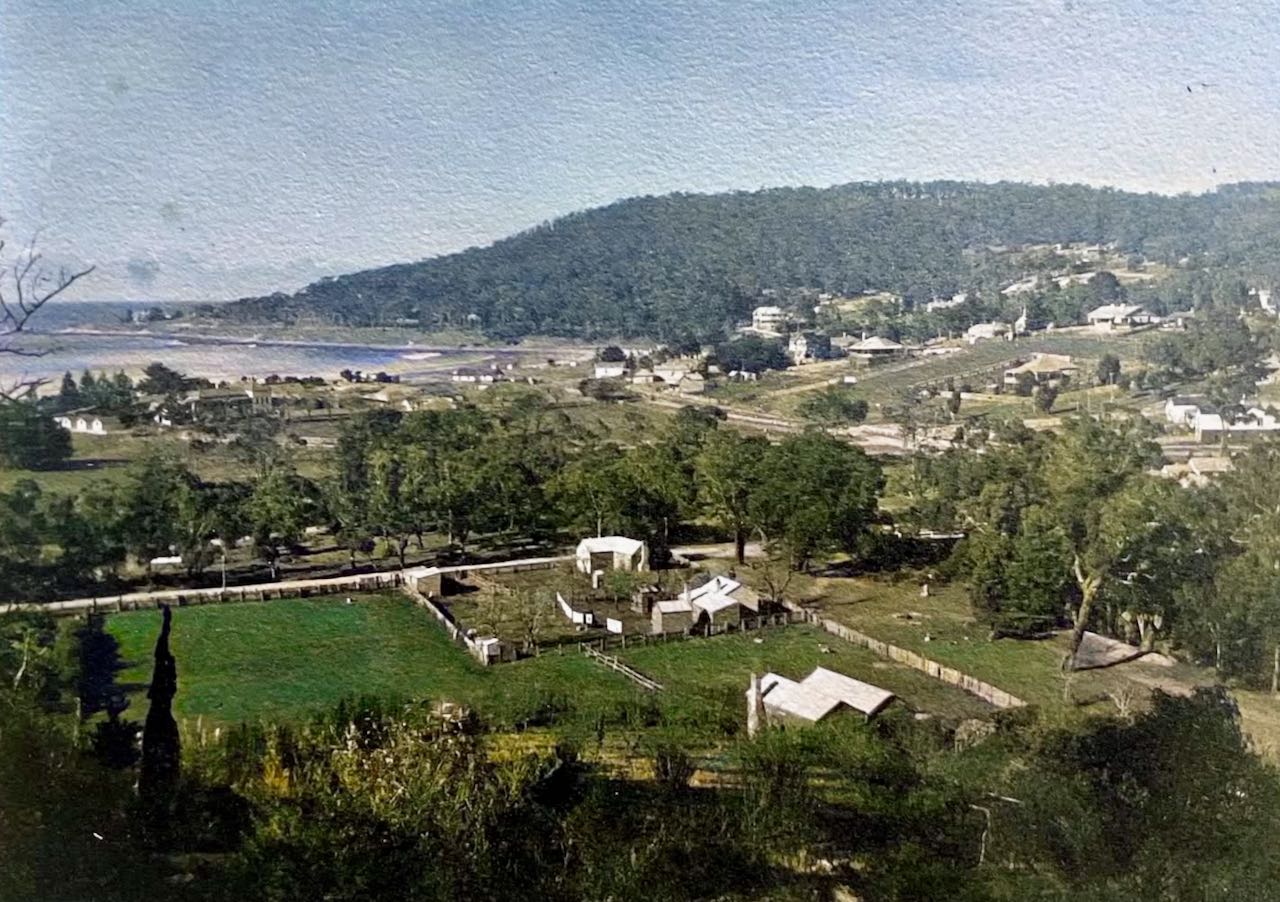
1926, Lorne
We were able to tell our visitors that the photo was taken from up the hill behind Waverley House, with Love’s paddocks in the foreground and a panorama of Lorne showing some 1926 buildings including Erskine House, Lorne Hotel and the Pacific Hotel. Love’s paddocks were originally part of the Waverley House estate, that included the land up behind Waverley House and the flat area to the west, now being the caravan park and supermarket.
The three bikies had left Adelaide on the 1 May 2026, reenacting a motorbike journey taken by Lionel Mills in 1926, the grandfather of Stephen and cousin, Timothy Wills, with friend Patrick Keane. The picture taken in front of the Pacific Hotel shows Patrick and Timothy with Stephen on the right.
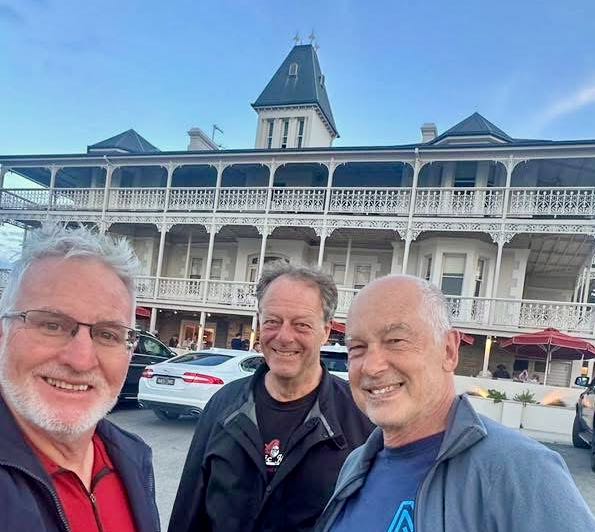
They report that they are making a more comfortable journey than their grandfather on a Harley Davidson Pan American and a Royal Enfield Himalayan with lots of coffee and food stops commensurate with their more senior years.
The trio left Adelaide on 1st April 2026, motorcycling the journey undertaken by their grandfather Lionel Wills and Lionel’s brother Phillip, exactly 100 years earlier. Stephen had ascertained the route from his grandfather’s photo album and an article he wrote in The Motorcycle Magazine (An Australian Scramble – Two English Motor Cyclists’ First Experience of Riding in Australia) and researching where roads were in 1926.
Lionel Wills, as a 24-year-old, rode a Harley Davidson and his 19-year-old brother Phillip rode a Henderson – another American bike. They took 3 full days to ride from Adelaide to Camperdown in Victoria due to poor roads, no roads, mechanical breakdowns, accidents, and running out of petrol. The photograph shows Lionel Wills with collar and tie and leather coat, between Mrs Manifold and Mr Manifold in 1926, at Wiridgil Homestead, near Camperdown and Colac.
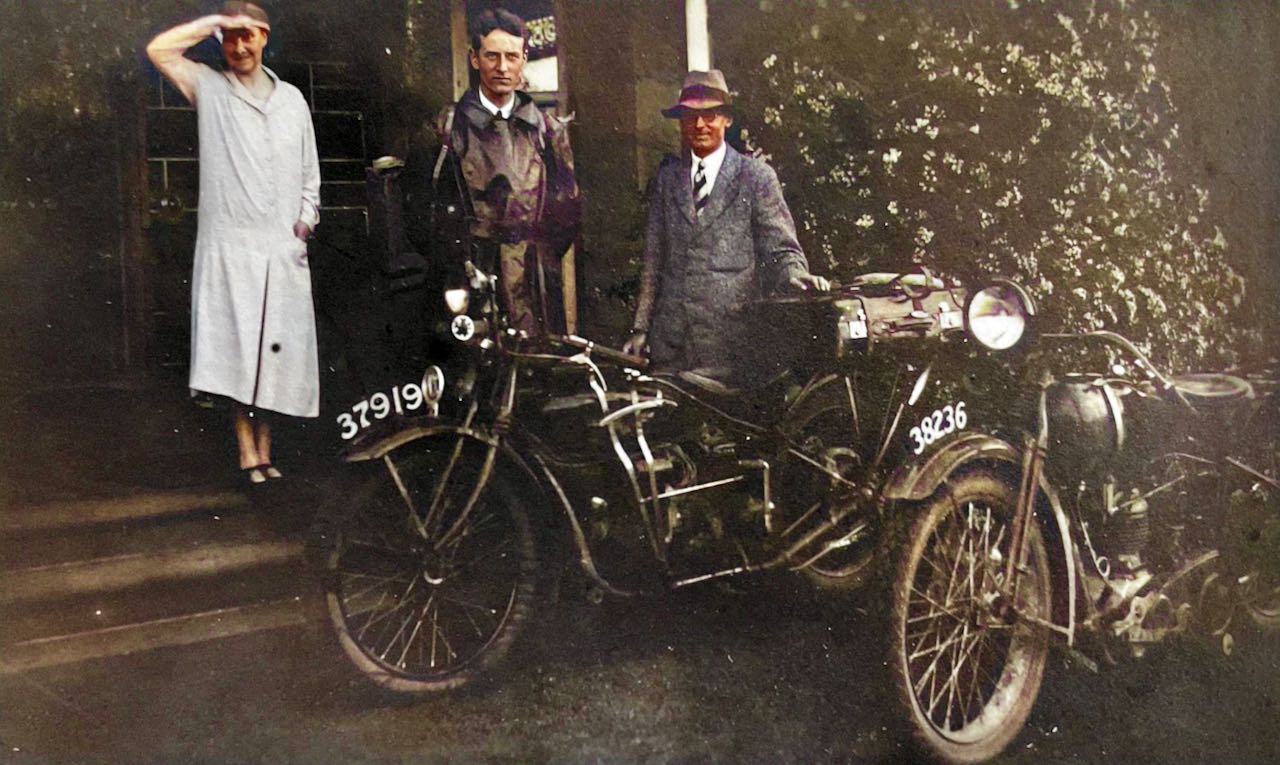
April 1926, Mrs Beatirce M.S. Manifold, Lionel Wills, T.P. Manifold, Wiridgil Homestead, Weerite Victoria Australia
From Gun Alley to Arthur Robbins Walk
People visiting Lorne may not notice, but locals know there is a laneway between Cumberland Resort and the shops that come off Browne’s Lane, called Arthur Robbins Walk.
Our research found that Frank Beaurepaire dug an alleyway down one side of the Cumberland, that was nicknamed ‘Gun Alley’. Lillian Beaurepaire, who was working at Carinya at the time, could run down the alleyway to the beach to save another life, having heard the ring of the lifesaving bell on the beach. It is understood that Lillian, as Lorne’s first lifesaver, wore her swimming suit under her work clothes, ready to respond in a life-saving emergency.
Gun Alley was later named Arthur Robbins Walk. With help from Lyn Davies we learnt a bit about Arthur Robbins.
He was born in 1921 at Mullimby, northern NSW, attended Repentance Creek Primary School and Lismore High School before leaving school at 15 to work on the family farm.
He was keen to fly and enlisted in the RAAF in 1942, served in the UK in RAF bomber command as a Lancaster Bomber pilot and completed 32 operations. Later he was transferred to Pathfinder squadron and flew 20 operations until the end of the World War II. He was awarded the Distinguished Flying Cross and the Pathfinder Force Badge.
In 1948, Arthur married Eunice Richards. He met Eunice while based in Brisbane at the boarding house run by Eunice’s mother. They then moved to Melbourne setting up a home in Strathmore, near Essendon Airport, welcoming the arrival of their only child Barry Robbins.
Arthur, Eunice and Barry then moved to Ombersley in 1956, a soldier settlement block, and worked hard to create a viable property and give service to the CFA, Durack School Committee and the Durack Church.
They purchased land in Lorne in 1964, built a house at 52 Smith Street in 1977 and retired to Lorne in 1979. Arthur loved bowls and was President of the Lawn Bowling Club. Arthur and Eunice gave good community support and worked as Meals on Wheels volunteers. Arthur worshipped at St Cuthberts and worked to maintain its gardens.
So isn’t it great that Arthur Robbins had a path named in his honour, which connects Smith Street to Mountjoy Parade for bowls or along Smith Street to St Cuthberts Church.
Linton Ferguson
Lorne Historical Society
A word from the Chair
Hello
Did you see the headlines, “Lorne Pier lights turned back on to guide the astronauts home to Earth”. Well maybe not, but it’s great to have our icon lit up again. Thank you GORCAPA.
What a special moment it was to see spaceship Artemis II touch down safely in the Pacific Ocean, after circling the moon on a journey that took 9 days and covered 1.1million kilometres (obviously no fuel shortages at NASA!).
A space mission like this evokes many emotions and provokes many questions. Such a journey is no joyride as we have seen with some past disastrous missions which resulted in multiple deaths. Even as the space capsule hurtled back to earth, we were told that re-entry into the earth’s atmosphere was one of the most dangerous phases of the journey. Thankfully all went well and the astronauts returned fit and well, with stories to tell.
How wonderful it was to see and hear the joy, humility and gratitude of the astronauts when so much of our media is filled with stories of aggression, hatred and destruction. There is hope for our future!
But the latest mission also raises some questions in my mind:
- Why did it take 53 years to get back to the moon? (The last Apollo mission was in 1972).
- Why does the moon have a “dark side”. If it revolves around the Earth and the Earth around the Sun, would it not at some point experience the Sun’s rays? And what happens when we have a solar eclipse? Is that not the moon blocking the Sun’s light?
- Why didn’t they drop in to see whether Neil Armstrong and Buzz Aldrin’s flag was still there (and possibly replace it)?
- How did they put a man on the moon in 1969 before computers as we know them were invented? I think I was graduating from slide rule to calculator and about to experience the joys of Cobol programming! To put it in perspective, your iPhone has 100,000 times the processing power of the computer that landed man on the moon 57 years ago! How amazing (and unbelievable) was the commitment, ingenuity and bravery of those involved in that mission?
- What’s next? Will we wait another 53 years for the next instalment?
*****
As we wake each day to reports of conflict and uncertainty in our world, we are blessed to have the sky, the sea and the bush on our doorstep, and we are grateful for and embrace the “bubble” that is Lorne. The images shared of stunning sunrises, moonlit nights and ever-changing seas add to our shared appreciation of where we live.
*****
Now it is time for me to say goodbye for a short time as Janet and I are heading to Europe (avoiding the Middle East at great expense!) for a few weeks. I leave this column in the safe hands of my deputy, Pete Spring.
Arrivederci
John
John Higgins
Chairman, Committee for Lorne
24th April, 2026
PARMAGEDDON

Edvard Munch: The Scream
There have been floods again up north. This time, Bundaberg has borne the brunt as the Burdekin broke its banks.
No one says enduring this is easy. The damage has been extensive, and the threats to land, livelihoods, and lives severe, as they are each time these events occur. Yet, time and again, and showing remarkable resilience, the locals—who have seen it all too often before—shrug it off and, as they always do, ‘get on with it’ and make the best of the situation.
On the TV news, I watched a young cub reporter from the big smoke conduct a handful of interviews with the locals. Clearly, he had never seen anything like this before. First came the usual inane, insensitive questions, like: ‘How does this make you feel?’, as the cameraman panned to the said locals’ house floating down the river in the background. Are they taught to ask such brain-dead questions in their tertiary courses? Surely not.
Then, following the university-taught proforma, our young newshound sought to highlight and exaggerate ‘the horror’ of it all. The local, looking a little bemused, replied with a resigned: ‘Ah well, we’ve dealt with this before, and we will deal with it again’, then followed it up with a dry and laconic: ‘It’ll be Parmageddon again down at the pub tonight!’
While no one wants them to, natural disasters do occur—they always have and always will—each sharpening the divide between those who live with rural/regional uncertainty and those accustomed to a cosy city life. The ability to accept and deal with climate hardship takes on different tones, depending on where one lives. Those in our cities invoke ‘climate change’, while those from the regions yawn, pour another cup of tea, and mutter, ‘Get a grip, it’s just our ever-changing weather’.
The ancient Greek philosophers once extolled the virtues of Stoicism, a philosophical mindset that encourages the development of personal resilience and virtue, while fostering the wisdom to distinguish between what we can and cannot control. The ‘Stoics’ taught that while external events are often uncontrollable, by controlling judgment and action, humankind can find inner calm by focusing on virtue, kindness, and rational action.
The quietly spoken ‘we will rebuild’ responses of stoic rural communities starkly contrast with the angry clamour of city folks who hold ‘protest marches’ if their trains are delayed, their intersection lights are out, or they misconstrue the millennial climate rhythms of the planet.
The disconnect between a rural local’s understanding of weather and climate systems, and the catastrophic ‘OMG, Chicken Little—duck! … the sky is falling’ reporting style of city-based journalists is, frankly, extraordinary.
‘Climate’ has acquired a poisonous taint. When paired with ‘change’, pure irrationality seeps in. Scratch a Western District farmer, and you will find someone who understands and ‘lives’ weather. On cue, they will roll out extraordinary swathes of weather records—serial historical data meticulously collected on their farms over decades—data sadly ignored by 21st-century, algorithm-driven, desk-chained BOM predictors! Yet these farmer-treasured, musty volumes and the wisdom they contain confirm the intricately documented weather that has blessed and bruised our sunburnt country for the past two or more centuries.
However, these year-on-year weather events, impressive though they are, are ‘small change’ when compared to the volcanic data that has dogged our recorded past.
One day, in the not-too-distant future—heads up, Chris Bowen—our sun will inevitably dim again beneath the eruptive shadow of the next super-volcano. Several well-known cataclysmic events have already occurred in recorded human history, let alone the geological markers that speak of even greater calamities in the past.
The Little Ice Age [c.1300-1850] was likely triggered by a cluster of massive tropical volcanic eruptions in the late 13th century, beginning with the eruption of Mt. Samalas [c.1257]. This led to the ejection of sulphur-rich aerosols into the stratosphere, which reflected sunlight and reduced surface warming.
Combined with reduced solar output during an incidentally concurrent solar minimum and sudden shifts in ocean circulation, the global cooling persisted for several centuries.
Even more impressive global cooling occurred in the 6th century AD, when a series of massive volcanic eruptions between 535 and 547 AD triggered profound, long-lasting cooling. Eighteen months of global darkness followed, causing crop failures and widespread summer snow near the equator.
We would be foolish to think this won’t happen again, and recent rumblings beneath Yellowstone—the world’s largest volcanic caldera in north-western Wyoming—have caused concern. It has blown its top many times before, and, like the overdue Californian earthquake [‘the big one’] from a slip on the San Andreas fault, a cyclical eruption of Yellowstone is believed to be ‘overdue’.
So … what will happen to our energy production if we hitch all our power generation to the sun and wind? While a great concept for a stable planet, Earth is anything but stable. The time will soon come again when the sun fades back to a dull-glowing orb—maybe not in our time, but soon.
Those who have experienced the eerie smoke-induced semi-darkness when a bush fire robs the light of day will know that this is one of the most cogent arguments for sustainable base-load power … and mark you, more super-volcano eruptions are inevitable, perhaps not in our lifetimes, but even if not, still soon.
In August 1883, the Indonesian island of Krakatoa literally blew itself apart, creating the loudest explosion in recorded history [Source: Wikipedia]. It was so powerful and violent that it was heard in Australia, India, and along the east coast of Africa. As Krakatoa vanished completely, nothing but a gaping crater remained. The tsunami it triggered measured 37m and devastated the surrounding coastlines, while global barometers in both hemispheres recorded that the shockwave circled the planet seven times.
In the months that followed, volcanic ash and aerosols circled the planet, and for several years global temperatures fell by nearly 1.2°C. As ambient sunlight dimmed, crop yields more than halved. The dramatic worldwide sunsets it produced inspired Edvard Munch’s haunting painting, The Scream. Today, even as Anak [the child of] Krakatau rises threateningly within the remains of Krakatoa, we must not forget that this nearby Indonesian behemoth is still very much alive.
Don’t get me wrong, I am not predicting any sudden earthquake or volcanic activity in our immediate region—even though our own Western District is a young, still-active volcanic region. However, a major volcanic eruption anywhere in the world, especially another Krakatoa in volcanic Indonesia or volatile New Zealand, could prove very problematic for a nation dependent on sunlight for energy.
As historical perspectives matter—whether in a cub reporter’s approach to localised events or in interpreting apparent changes in global weather patterns—it may be wise to caution against a blinkered vogue for political short-termism and to keep an eye on the long game. Geo-time is measured in millennia, epochs, and eras, and is at the mercy of an unpredictable fuse.
John Agar
Feature Writer
From the Chairman
Hello
Whilst the Chairman of Committee for Lorne, John Higgins and his wife are carousing around Europe it falls to the rest of the Committee to produce his weekly column. Cheers John!
Last weekend Lorne competed against Colac Imperials at Stribling Reserve. All football teams from Under 12 to Seniors were successful – a great result. In relation to the Seniors win, Casey Tutungi who is assisting Coach Ed Curnow said, “A great win. Sets our season up, really”. Our Netball teams did not fare as well but there were some brave tussles.
On Saturday the teams travel to Elliminyt Recreation Reserve to take on South Colac. Good luck to all!
*****
Saturday is ANZAC Day and, as usual, there will be a Dawn Service at ANZAC Memorial Park at 7 am, to be followed by Gunfire Breakfast, organised by Lorne Men’s Shed, in the grounds of the Bowls Club. The march to ANZAC Memorial Park from Lorne Community Connect will take place at 10.45am followed by the formal service and laying of wreaths at 11am. Each year the number of people attending services on ANZAC Day continues to grow. We hope to see you there.
Another ANZAC tradition in Lorne is displaying the photographs of those Lorne people who have served in various conflicts, on the windows at Lorne Foodworks. Thanks to Foodworks for allowing this tradition to continue and a big thank you to Wendy Jarratt and John Ford who ,on behalf of the Lorne Historical Society, arrange the display. Much appreciated. As you are leaving the checkout, you will see one of the posters contains two QR codes. Scanning these codes will take you to the website of the Lorne Historical Society, to pages containing more information on the story of ANZAC Memorial Park and the Avenue of Honour.
The new Avenue of Honour, located in Smith St outside the School, was a School project and is the work of four students who conceptualised the remodelled Avenue and planned its installation. It was officially opened by our Federal Member Dan Tehan, in November last year. If you haven’t been for a look, it’s well worth your time particularly as we remember those who served and sacrificed.
*****
This week we have started to experience Lorne as it enters its “quiet time”. Summer has gone, school holidays are over, and whilst the weather is still mild, there have been portents of things to come as we brace ourselves for Winter in Lorne. The summer season was not the best on record for our business community in Lorne, affected by alarmist media reporting of nearby fire and floods in January. There is now a promotion to encourage people to visit and stay in Lorne with weekly prizes. This promotion is available between April 16 and June 26, 2026. Now is the time to support local businesses and encourage friend and family to visit. You can read more about the promotion here – www.lovelorne.com.au.
On behalf of our chairman,
Cheers
Pete Spring